Legacy systems are expensive to maintain, outdated, and often insecure. They consume up to 80% of IT budgets and struggle with modern demands. Low-code platforms offer a faster, cost-effective way to modernize these systems, reducing development time by up to 90% and addressing the growing developer shortage. Here's a quick look at five leading tools:
- Mendix: Simplifies integration with modern systems using tools like External Entities and visual data mapping. Offers cloud-native scalability and one-click deployment.
- Dell Boomi: Focuses on integration with 1,500+ pre-built connectors and API-first design, enabling faster data migration and hybrid cloud compatibility.
- Fivetran: Automates ELT processes with 700+ connectors, real-time data sync, and Change Data Capture for seamless database migration.
- Hevo Data: Provides a no-code interface with real-time data replication, automated schema updates, and scalable architecture.
- Astera Centerprise: Uses AI-powered automation for data mapping, real-time synchronization, and high-performance parallel processing.
These platforms help businesses modernize faster, cut costs, and reduce technical debt. Below is a quick comparison of their features.
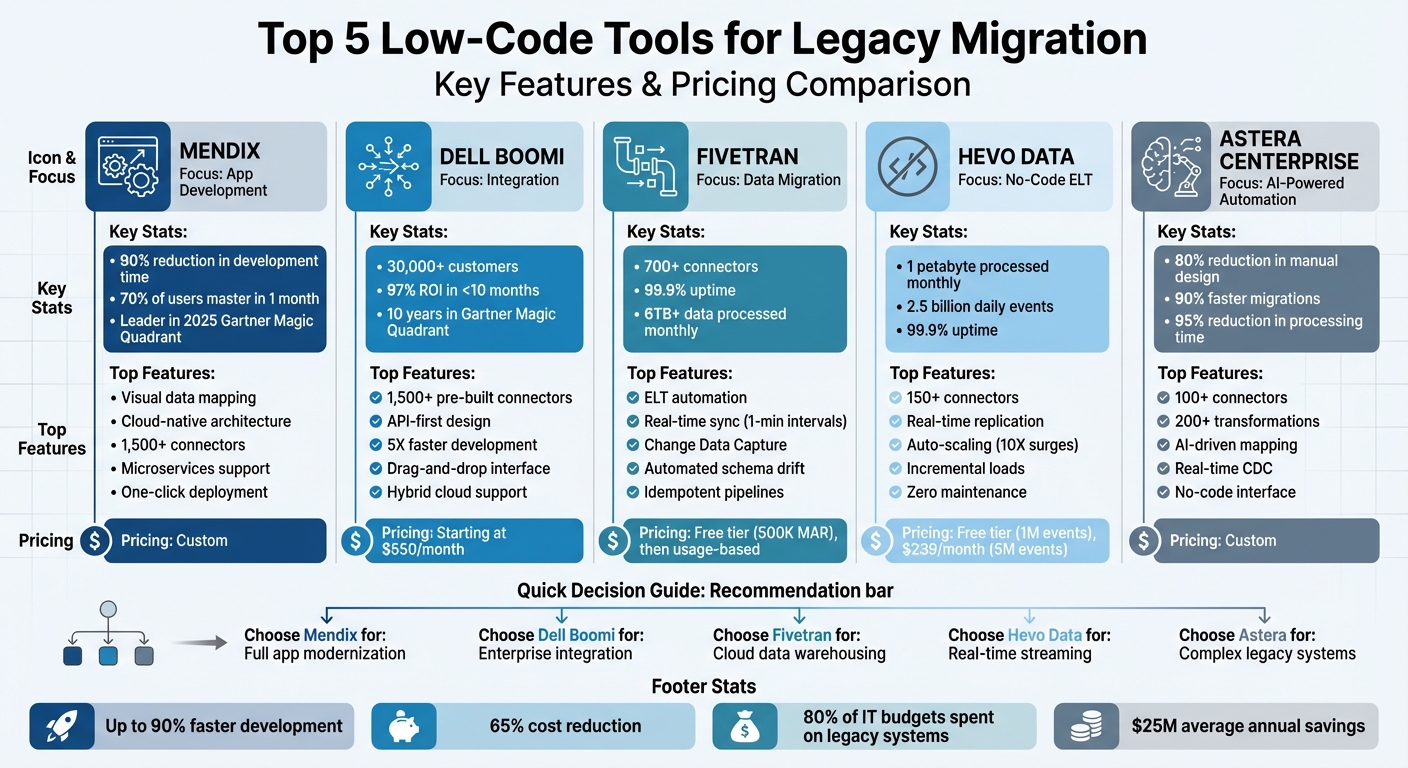
Low-Code Tools for Legacy Migration: Feature and Pricing Comparison
Speed to Mission: How Low-Code Is Quietly Rewiring Federal IT
sbb-itb-3a330bb
Quick Comparison
| Platform | Focus Area | Key Features | Pricing (Starting) |
|---|---|---|---|
| Mendix | App Development | Visual data mapping, cloud-native, microservices | Custom |
| Dell Boomi | Integration | 1,500+ connectors, API-first design | $550/month |
| Fivetran | Data Migration | ELT automation, real-time sync | Free tier (500K MAR) |
| Hevo Data | No-Code ELT | Incremental loads, schema drift handling | $239/month |
| Astera Centerprise | AI-Powered Automation | Real-time sync, 200+ transformations | Custom |
These tools address legacy migration challenges with features like pre-built connectors, automated processes, and scalable architectures. Choose based on your integration, data migration, or modernization needs.
1. Mendix
Mendix has earned recognition as a Leader in the 2025 Gartner® Magic Quadrant™ for Enterprise Low-Code Application Platforms, offering a robust solution for businesses managing legacy system migrations. Its key strength lies in bridging the gap between outdated systems and modern technologies without requiring a full system overhaul.
Integration Capabilities
Mendix Connect supports a wide range of protocols, including REST, SOAP, JDBC, OData, GraphQL, and MQTT. With tools like the Catalog, Database Connector, Marketplace, and Connector Kit, it enables seamless integration with platforms such as SAP, Salesforce, AWS, Snowflake, and Kafka. These capabilities make it easier to connect legacy systems to modern applications while simplifying data migration processes.
Data Migration Support
Mendix takes the complexity out of data migration with External Entities, which enable data virtualization. This allows applications to interact with data from external systems via OData as though the data were local, eliminating the need for physical migration upfront. Additionally, its visual data mapping feature transforms incoming data structures - whether JSON, WSDL, or XML - into usable domain models with minimal effort.
"Low-code makes business topics more understandable because it's a business process. So, you have a common language that we can talk about." – Chris Neuteboom, Product Owner, Order Management System, PostNL
The platform’s efficiency is noteworthy, cutting software development time by 90% for many users. Plus, 70% of new users report mastering the system within just one month. These features make Mendix a strong choice for businesses seeking scalable and efficient modernization solutions.
Scalability for Modernization
Mendix’s cloud-native, containerized architecture ensures automatic scalability. Its microservices-based approach allows legacy systems to be broken down into smaller, independent components that can be scaled and updated individually. With one-click deployment, applications can be launched across public, private, hybrid clouds, or on-premises environments. Built-in auto-healing ensures mission-critical applications remain operational, while recent updates, like zero-downtime deployments, allow updates without disrupting operations. The Control Center offers centralized visibility into application architecture, data models, and user bases, making it easier to manage complex migration projects.
Ease of Deployment and Maintenance
A case study highlights how Mendix reduced deployment time for a critical newsroom application from one month to just five days. The platform’s 24/7 Mendix Forum ensures most technical queries are addressed within 30 minutes, providing reliable support.
"What Mendix gave us was a fast track for development of the smaller demands, or the things that can be done in an agile way with rapid prototyping." – Mark Vermeer, CIO, City of Rotterdam
With tools like the Model SDK and APIs, Mendix facilitates programmatic migration and adjustments to application models. This flexibility helps prevent vendor lock-in by enabling data and model exports. Automated testing and performance monitoring are also built-in, reducing technical debt and ensuring smoother transitions during complex migrations.
2. Dell Boomi
Dell Boomi is a cloud-based iPaaS platform that has been a standout in the Gartner Magic Quadrant for ten years straight. With over 30,000 customers and a 97% ROI achieved in under 10 months, it’s clear why organizations turn to Boomi for integration, data migration, and scalability solutions.
Integration Capabilities
Modernizing outdated systems hinges on seamless integration, and Boomi delivers with over 1,500 pre-built connectors for applications like SAP, Oracle, PeopleSoft, Salesforce, Workday, and ServiceNow. Its drag-and-drop interface empowers both developers and non-technical users to create integrations without the hassle of outdated protocols like SOAP. This is a big deal, considering that up to 70% of IT budgets are often spent maintaining hand-coded integrations. Boomi replaces these fragile, point-to-point connections with a more scalable and efficient architecture.
"Even with no Boomi training, we were soon rolling out integrations in days with Boomi that took months and months of development time on our previous platform." – John Parker, Lead Software Engineer & Integrations Architect, Cornell University
Boomi’s API-first approach also enables teams to wrap legacy functions in modern APIs, eliminating the need for custom coding. This makes older systems compatible with today’s cloud applications. For example, Riverbed used Boomi to achieve 3X faster integration rollouts and cut their sales quote process by 60%, reducing turnaround times from days to just hours.
Data Migration Support
Smooth data migration is crucial during legacy upgrades, and Boomi’s Data Hub ensures consistency through master data management and governance. Its automated ELT (Extract, Load, Transform) pipelines simplify moving data from legacy systems to modern cloud platforms.
Boomi Suggest, powered by insights from 300 million integrations, recommends accurate data mappings and workflows, reducing manual errors and speeding up complex migrations. Additionally, its exception management feature provides real-time email alerts for data discrepancies or process failures, keeping teams informed.
"Boomi has enabled us to go faster than ever before...developing integrations went from 6-12 months to mere days." – Andrew Burnet, Head of Development & Operations, Origin Energy
In one case, a life sciences company partnered with Apps Associates to integrate Oracle Cloud ERP with Salesforce and Workday using Boomi. This allowed them to standardize operations, eliminate customizations, and retire outdated systems nearing end-of-life.
Scalability for Modernization
Enterprise modernization demands flexibility, and Boomi’s cloud-native platform rises to the challenge. Its "Molecule" runtime supports high availability and can handle millions of transactions, making it suitable for organizations of any size. Alstom, for instance, saw a 400% boost in application data load speeds after implementing Boomi.
Boomi also supports a bi-modal strategy, allowing businesses to modernize incrementally while keeping legacy systems operational. Integration development is up to 5X faster than with traditional middleware, enabling teams to adopt a phased approach rather than overhauling everything at once.
Ease of Deployment and Maintenance
Boomi’s low-code interface simplifies deployment, reducing the need for specialized technical expertise. Unlike traditional Enterprise Service Buses that require large teams and manual updates, Boomi integrations typically need just one or two developers and include automated updates.
"The Boomi Platform is much more drag-and-drop, and allows people to connect things up very simply." – Chris Moon, Chief Information Officer, EPA Victoria
The platform offers flexible deployment options - cloud, on-premises, or hybrid - tailored to meet regulatory and data residency requirements. Automated updates further reduce the maintenance burden, and the Boomiverse community, with over 310,000 members, provides valuable peer support and best practices. With compliance to standards like HIPAA, PCI DSS, and SOC 1 and 2, Boomi ensures secure and efficient legacy modernization.
3. Fivetran
Fivetran streamlines ELT processes, making it easier to migrate legacy data to modern cloud platforms. It offers automated, low-code solutions that simplify legacy modernization projects. With over 700 pre-built connectors and a 99.9% uptime guarantee, it’s built to handle enterprise-scale migrations [29,30].
Integration Capabilities
Fivetran connects with legacy systems like SAP, Oracle, SQL Server, and DB2 through connectors that require minimal setup. Using Change Data Capture (CDC), it mirrors database changes in near real-time, ensuring source and target systems stay aligned. Its automated schema drift handling detects changes in legacy source structures and updates the destination schema automatically [34,37].
"Fivetran has revolutionized our global SAP data delivery, reducing time to insights from days to minutes. We can react swiftly to market changes and track our sustainability efforts at any moment."
– Gerardo S. Reyna Caamaño, Global Data Architecture Manager, Cemex
A standout example is Coke One North America, which used Fivetran’s CDC capabilities to migrate its SAP system from on-premises DB2 to SAP S/4HANA on Google Cloud. This setup replicated ongoing transactions into Google BigQuery, enabling real-time analytics for 35,000 employees. For businesses with niche legacy systems, Fivetran’s Connector SDK allows teams to create custom integrations [35,36].
These integration features make data migration smoother and more efficient.
Data Migration Support
Fivetran’s ELT framework loads raw data into the destination warehouse before applying transformations. Its idempotent pipelines ensure data integrity by restarting from the last successful state, preventing duplicate records. For industries with strict regulations, Fivetran offers hybrid deployment options that keep sensitive data within the customer’s environment [29,35].
"We've been able to set up data pipelines in under two minutes. The work that would've previously taken engineers weeks, if not months, to fully build, test and deploy, Fivetran makes possible in minutes."
– Ashley Van Name, Director of Data Engineering, JetBlue
Oldcastle Infrastructure transitioned from custom ETL scripts to Fivetran’s automated connectors while migrating from on-premises SQL Server and NetSuite to Snowflake. This change saved the company approximately $360,000 annually in engineering costs.
Scalability for Modernization
Fivetran is built to handle large-scale enterprise needs. It processes over 6 TB of data monthly for its enterprise clients, with sync frequencies as low as one minute on its Enterprise tier [29,35]. National Australia Bank replaced outdated legacy systems with Fivetran and Databricks to unify its data platform. Joanna Gurry, Executive of Data Platforms at National Australia Bank, noted:
"Removing complex legacy technology from our ecosystem and replacing it with Fivetran and Databricks to unify our data has been the springboard to enable all of the exciting generative AI use cases we are pursuing."
Cemex leveraged Fivetran to connect over 1,800 global facilities in real time, cutting the time needed to deliver SAP data insights from days to just minutes. Pfizer also adopted Fivetran to standardize data replication, enabling real-time analytics across the organization.
Ease of Deployment and Maintenance
Fivetran’s fully managed service eliminates the need for API maintenance. It integrates with dbt to perform post-load transformations directly in the destination warehouse [34,31]. Its pricing is based on Monthly Active Rows (MAR), with a free tier offering up to 500,000 MAR. A 14-day free trial provides access to all connectors, including premium ones like SAP and Oracle [32,33].
Tinuiti, a marketing firm, used Fivetran to migrate to a centralized data lake on AWS S3, reducing manual pipeline maintenance by 80%. This shift enabled near real-time reporting across more than 100 channels, saving the company 150 hours of API maintenance each month. Additionally, Fivetran meets high security standards, holding certifications such as SOC 1 & 2, GDPR, HIPAA, ISO 27001, and PCI DSS Level 1.
4. Hevo Data
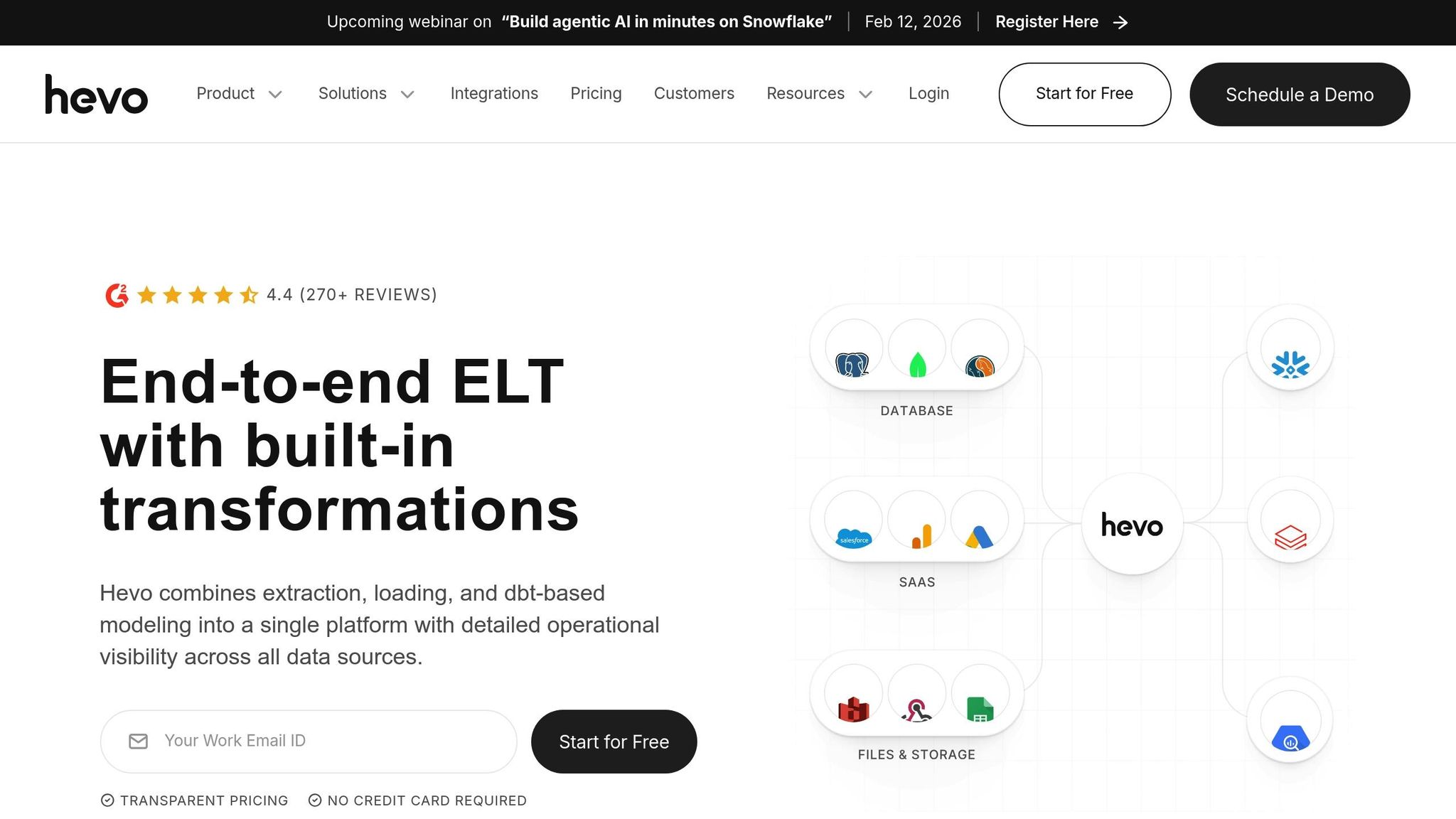
Hevo Data takes the concept of low-code platforms a step further by offering a no-code ELT solution that combines simplicity with powerful functionality. The platform processes over 1 petabyte of data monthly and handles more than 2.5 billion daily events, making it a solid choice for businesses looking to migrate legacy systems to modern cloud warehouses.
Integration Capabilities
Hevo comes equipped with more than 150 pre-built connectors for widely-used databases like Oracle, SQL Server, MySQL, and PostgreSQL, as well as a variety of SaaS applications and file storage systems. Its use of log-based Change Data Capture (CDC) ensures near real-time replication of data changes. For legacy systems that lack direct support, Hevo provides a REST API, enabling custom connector development.
Take Infinity Brands, for example. This South African franchisor transitioned from a traditional ERP system to the cloud-based CIN7 Omni using Hevo Data. By automating data ingestion into SQL for Power BI reports across 41 stores, they supported over 1,000 users. This migration played a key role in driving a 63.92% year-over-year growth for their ACDC Express brand, generating over R500 million in turnover within a year.
Data Migration Support
Hevo simplifies data migration with automated schema drift detection, which updates changes in legacy structures without requiring manual intervention. Its incremental data load feature ensures only modified records are transferred in real time, optimizing bandwidth and keeping destination warehouses up to date.
"As some members in our team who come from non-tech background having knowledge in data, this tools helps them get the work done faster without having to worry about the programming and infrastructure side of it."
– Nikhil S., Data Science Engineer
Companies like ThoughtSpot have used Hevo to modernize their operations, achieving an 85% reduction in platform costs while maintaining 100% uptime. Similarly, Postman connected more than 40 data sources through Hevo, saving 40 hours each month on manual pipeline maintenance.
Scalability for Modernization
Hevo’s auto-scaling capabilities dynamically allocate resources to handle data surges up to 10×, while its streaming-first architecture can scale up to 100× with minimal latency. For instance, Deliverr doubled its data volume and saved over 80 hours of manual work per month, boosting team productivity by 10%. Customers have reported a 75% reduction in total cost of ownership, with annual savings exceeding $60,000. The platform also delivers 99.9% uptime and complies with SOC 2 Type II, GDPR, and HIPAA standards.
Ease of Deployment and Maintenance
Hevo makes deployment and maintenance straightforward. Its user-friendly point-and-click interface enables pipeline setup in just a few minutes, requiring no coding expertise. The platform ensures "zero maintenance" by automatically recovering from record failures and managing schema changes. For data transformations, users can choose between drag-and-drop tools, Python-based options, or integration with dbt Core.
Pricing starts with a free tier that includes 1 million events per month. Paid plans include the Starter plan at $239/month (billed annually, for 5 million events) and the Professional plan at $679/month (for 20 million events). Hevo also offers 24/7 support and boasts strong customer reviews, with a 4.5/5 rating on G2 and a 4.7/5 rating on Software Advice.
5. Astera Centerprise
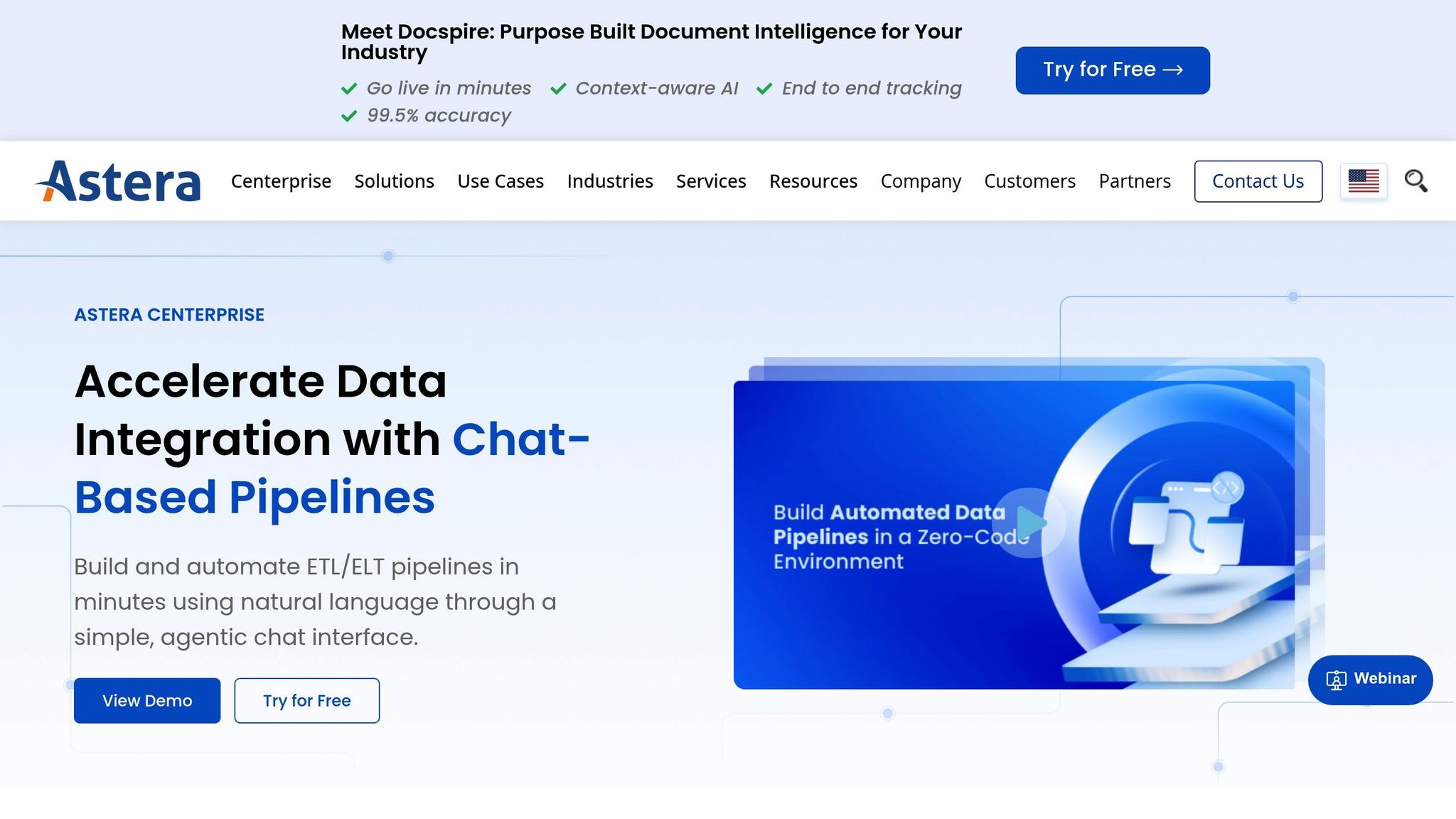
Astera Centerprise is a no-code platform designed to simplify legacy system migrations using AI-powered automation. Its chat-based interface, combined with natural language processing (NLP), creates data pipelines, models, and mappings, reducing manual design efforts by up to 80%. This makes it an excellent solution for organizations grappling with poorly documented legacy systems, where traditional mapping methods could take weeks of developer time.
Integration Capabilities
Astera Centerprise comes equipped with over 100 pre-built connectors that bridge the gap between outdated systems and modern cloud platforms. It can extract data from older systems like COBOL, IBM DB2, SAP BAPI, and various EDI formats (X12, EDIFACT, HL7) while integrating seamlessly with platforms like Snowflake, Amazon Redshift, and Google BigQuery. Its API management tools allow teams to wrap legacy functionality within modern interfaces, enabling gradual modernization without overhauling entire systems. Additionally, its AI-driven semantic mapping automatically aligns source and target fields, making it especially useful for poorly documented legacy schemas. These features streamline data migration and integration processes.
Data Migration Support
Astera Centerprise doesn't just connect systems - it ensures the data being migrated is accurate and reliable. The platform includes tools for data profiling, cleansing, and validation to maintain high data quality. Its Change Data Capture (CDC) feature synchronizes legacy and modern systems in real time, minimizing downtime during transitions. For example, CoWorx Staffing leveraged Astera to automate PDF file processing, cutting payroll data consumption time by 95%. Similarly, Achievers saw a dramatic improvement, with Senior Data Architect Mario Ferrer reporting a reduction in data integration time from two weeks to just five minutes. This efficiency allowed their developers to focus on more critical tasks.
Scalability for Modernization
When it comes to large-scale modernization, scalability is crucial. Astera's powerful engine supports high-performance parallel processing, making it suitable for enterprise workloads. The platform can scale data pipelines without performance loss and includes over 200 built-in transformations to handle complex data movements. Organizations using Astera report completing migration and consolidation projects up to 90% faster, thanks to its automation capabilities. The platform also adapts to changes in source schemas automatically, reducing the need for manual updates during long-term modernization efforts.
Ease of Deployment and Maintenance
Astera's drag-and-drop interface simplifies the management of complex migrations, eliminating the need for SQL or coding expertise. It automatically handles schema drift, updating legacy structures without manual intervention. Patrick Van Vlierberghe, IT Manager, highlighted the platform's versatility:
"It is a good thing to have Astera Data Pipeline, and while we bought it mainly for data migration, I see a lot more opportunities to use it. And that's, of course, a winning situation".
Astera has earned recognition as a "Strong Player" in both ETL and data mapping categories on G2, with users praising its ability to boost developer productivity and streamline workflows. The platform offers flexible licensing tailored to specific use cases, with pricing available through its sales team.
Feature Comparison
This section highlights and compares key features of some leading low-code platforms designed for legacy migration.
Mendix is tailored for enterprise-level digital transformation, focusing on converting legacy systems into independent microservices. It supports protocols like REST, SOAP, JDBC, and OData, offering flexibility in deployment architectures. A great example of its efficiency is The Boston Globe's newsroom corrections database. Using Mendix, development time dropped from over a month with Lotus Notes to just five days in 2023. However, users typically need one to three months of training to fully leverage the platform.
On the other hand, Dell Boomi acts as a powerful integration hub, boasting more than 1,500 endpoint connections. This makes it an excellent choice for hybrid cloud integration tasks. Starting at $550 per month, it simplifies connecting disparate systems through an intuitive drag-and-drop interface. For instance, Alstom saw a 400% boost in data load speed after modernizing its application data loading processes with Boomi in 2021.
For data-driven migrations, Fivetran and Hevo Data offer unique approaches. Fivetran provides over 900 pre-built connectors with standard sync intervals of 15 minutes, while its Enterprise tier supports faster one-minute syncs. Pricing is based on Monthly Active Rows (MAR), with a free tier covering up to 500,000 MAR. Meanwhile, Hevo Data relies on a Kafka-based streaming architecture for real-time migrations. With 150+ connectors focused on operational needs, its plans start at $239 per month (billed annually) for 5–50 million events. A free tier allows one million events monthly.
Finally, Astera Centerprise stands out with AI-driven automation that can reduce manual design work by up to 80%. It offers over 100 pre-built connectors and 200+ built-in transformations, along with flexible licensing options to suit different needs. The platform also handles schema drift automatically, removing the need for SQL or coding expertise.
Conclusion
The five low-code tools discussed here can cut operational costs by up to 65% and speed up development cycles by as much as 90% compared to traditional coding methods. With legacy systems eating up 60–80% of IT budgets in many organizations, modernization is no longer optional - it’s a necessity.
The numbers tell a compelling story. Some businesses have seen developer productivity increase 4× and deployment cycles shrink by 70%. For instance, Maeda Corporation successfully converted 1,000 Lotus Notes databases into over 200 modern web applications in just two years, achieving a 5× boost in user satisfaction. On average, companies that embrace modernization report $25 million in annual savings.
Low-code tools make modernization more accessible through features like visual development interfaces, AI-driven analysis, pre-built connectors, and the ability to break down monolithic systems into smaller, more manageable microservices. They also help tackle the growing developer shortage, with an estimated 4 million unfilled positions looming by 2026. These advantages highlight the importance of selecting the right low-code platform for your needs.
Whether you're focused on SAP low-code integrations, real-time data pipelines, or large-scale enterprise transformations, your choice of platform should align with your specific goals, budget, and technical constraints. For detailed comparisons and resources to help you make an informed decision, check out the Best Low Code & No Code Platforms Directory. This directory offers side-by-side evaluations to help you find the perfect fit for your modernization journey.
FAQs
How do I choose the right tool for my legacy migration?
Choosing the right tool hinges on your organization’s specific goals, technical requirements, and the type of legacy systems in place. Some key considerations include ease of use, API integration capabilities, and development speed. For instance, if you’re looking to streamline interface updates, no-code platforms can be a practical solution. On the other hand, tools like AWS Mainframe Modernization are tailored for deeper core transformations. Think about the outcome you’re aiming for - whether it’s system migration, API enablement, or something else entirely. To make a well-informed choice, explore resources like comparison directories that can help you weigh your options effectively.
Can I migrate in phases without shutting down the legacy system?
Yes, it’s possible to migrate in phases while keeping the legacy system operational. With modern low-code tools and strategies, you can implement incremental updates, allowing the legacy and new systems to work side by side. This method reduces risks and ensures uninterrupted business operations during the transition.
What data risks should I plan for during migration?
During a legacy system migration, several risks can emerge that could derail the process if not addressed carefully:
- Data loss: This can happen due to insufficient backups or compatibility issues between old and new data formats.
- Security breaches: Data transfers often expose sensitive information to potential threats if security protocols aren’t airtight.
- Compliance issues: Failing to adhere to governance standards can lead to regulatory penalties or legal complications.
- Data mapping errors: Mistakes in mapping data between systems may result in inaccuracies that ripple across operations.
- Operational downtime: Interruptions during migration can disrupt everyday business activities, impacting productivity and revenue.
To tackle these challenges, focus on meticulous planning, adopt phased migration strategies, validate data thoroughly at every step, and implement strong security measures. These steps are essential for ensuring a reliable and compliant transition.