Choosing the right blockchain platform in 2026 is critical for project success. With over 1,000 platforms available and the blockchain market projected to reach $1.4 trillion by 2030, your decision impacts scalability, costs, and security. This guide simplifies the process by breaking it into key factors:
- Define your goals: Identify your use case - payments, gaming, supply chain, or DeFi - and choose between public, private, hybrid, or consortium blockchains.
- Evaluate scalability: Platforms like Solana excel in high transaction volumes (65,000 TPS), while Ethereum Layer 2 solutions balance cost and performance.
- Consider costs: Transaction fees vary widely - $0.00025 on Solana vs. $50+ on Ethereum during peak usage.
- Assess technical features: Look at transaction speed, smart contract compatibility, and integration with low-code tools.
- Prioritize security and compliance: Platforms like Hyperledger Fabric and Hedera offer strong privacy and regulatory features for sensitive projects.
- Integration tools: Choose platforms with robust APIs, SDKs, and support for low-code and no-code development tools.
The best platform depends on your specific use case, technical needs, and budget. Solana suits high-frequency apps, Ethereum dominates DeFi, and Hyperledger Fabric works for private enterprise solutions.
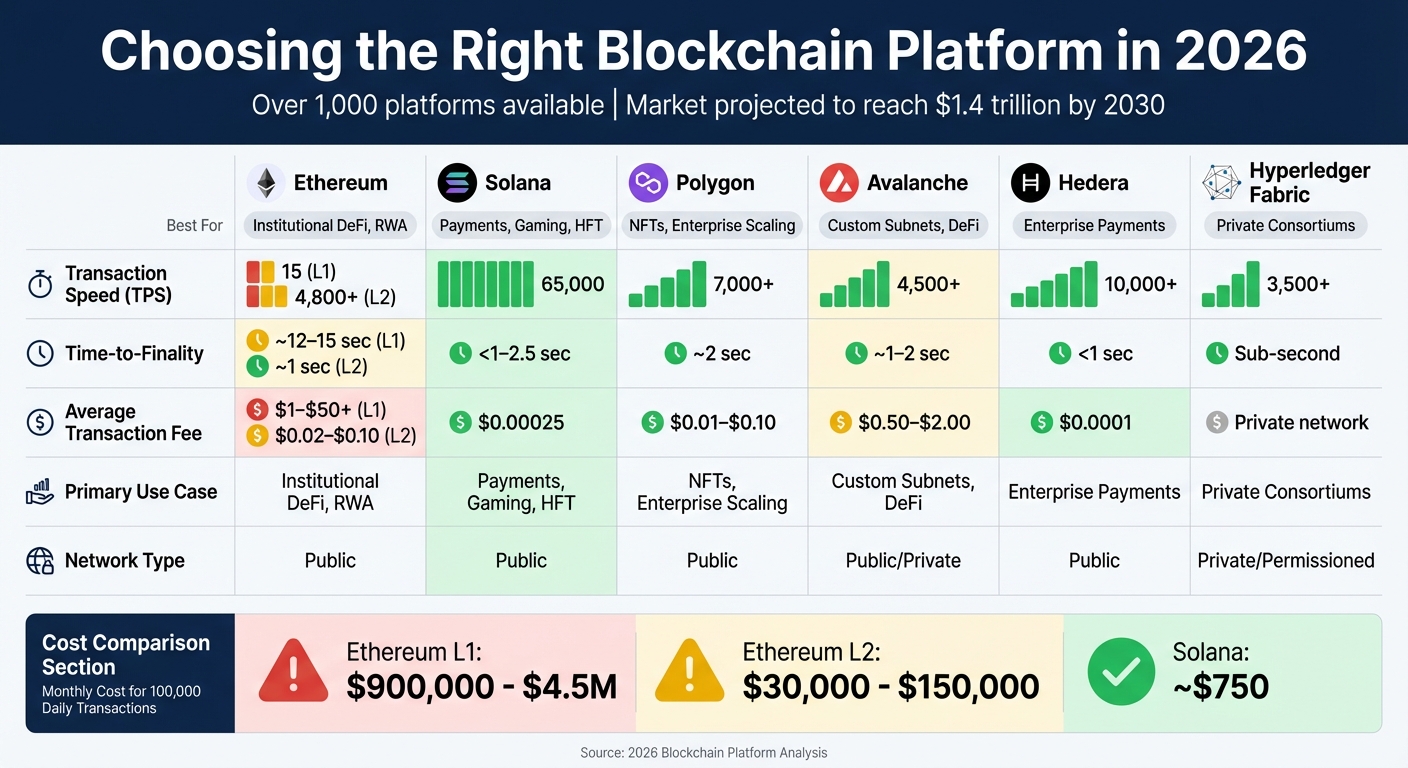
Blockchain Platform Comparison 2026: Speed, Costs, and Use Cases
How to Choose the Right Blockchain for My Token
sbb-itb-3a330bb
Define Project Requirements and Use Cases
When planning a blockchain project, it's crucial to outline your objectives and identify how blockchain technology will deliver value. This involves pinpointing your core business goals, understanding the specific scenarios where blockchain fits, and estimating the transaction volumes your project will need as it scales.
Clarify Business Objectives
Start by defining the problem you're solving with blockchain. For example, do you need confidential transactions limited to approved participants - critical in sectors like healthcare or finance? Or is maximum transparency a priority, such as in voting systems or charitable donations? Your answer will determine whether you should opt for a public, private, consortium, or hybrid blockchain setup.
For developers working with low-code and no-code platforms, cost efficiency often takes center stage. Gas fees and resource usage can either support or undermine a project's viability, especially for startups managing high-volume operations like gaming or microfinance. Another major focus is automation through smart contracts, which can streamline processes by eliminating intermediaries and reducing human error. This is particularly useful for automating trust-based systems.
"For CTOs and enterprise architects, the decision of which blockchain platform to build on is not a technical footnote; it is a multi-million dollar strategic choice." - Developers.dev
Your governance model also plays a big role. A B2B model may demand high levels of privacy, while a B2C model might prioritize transparency. This choice can help narrow down your options, like permissioned blockchains such as Hyperledger Fabric for privacy or public blockchains like Ethereum or Solana for transparency. Additionally, you’ll need to calculate your required transactions per second (TPS) and acceptable cost per transaction. For instance, high-throughput platforms are better suited for frequent, low-value transactions (like loyalty points), while platforms with strong compliance features are ideal for high-value, sensitive transactions.
By identifying these objectives, you can better match your project's needs to the right blockchain scenarios.
Identify Use Case Scenarios
Once your objectives are clear, focus on the specific use cases you aim to address. Different blockchain platforms excel in different areas. Here's a look at some scenarios:
- Institutional DeFi: Ethereum leads the way, with over $50 billion in total value locked (TVL) and high-volume protocols like AAVE dominating the space.
- Consumer Payments: For fast settlements and minimal fees, platforms like Solana and Algorand are top choices. Solana, for example, reported 2.7 million daily active users in January 2026, thanks to its low-cost, high-speed transactions.
- Supply Chain Tracking: Private consortium blockchains like Hyperledger Fabric are ideal for industries like logistics and food safety. Companies like Walmart and Maersk use this setup for secure, confidential transactions.
- Gaming and NFTs: Platforms like Solana, BNB Chain, and Polygon handle high-frequency microtransactions effectively. Major brands like Disney, Starbucks, and Reddit have adopted Polygon for its low minting fees and Ethereum-compatible security.
- Digital Identity: For projects requiring formal verification and compliance with government regulations, consider platforms like Cardano and Algorand.
- Cross-Chain Functionality: If your project involves moving assets across networks, platforms like Polkadot and Cosmos provide robust interoperability solutions.
The enterprise sector is increasingly shifting toward permissioned chains for areas like supply chain management and healthcare, with adoption growing by 45% year-over-year.
Estimate Required Scalability
Scalability is pivotal for ensuring your platform can handle growth without performance bottlenecks. Smaller projects processing fewer than 100 daily transactions can function on almost any blockchain. However, projects requiring over 10,000 daily transactions often need alternative Layer 1 blockchains or Layer 2 solutions to remain cost-effective.
Throughput capabilities vary widely among platforms. For instance:
- Solana: Capable of 65,000 TPS with sub-second finality.
- Ethereum Layer 1: Processes approximately 15–30 TPS.
- Ethereum Layer 2: Post-Fusaka Upgrade, Layer 2 solutions like Arbitrum can now handle up to 40,000 TPS.
Data storage is another factor to consider. For example, Ethereum archive nodes require over 14 terabytes of storage, while Solana validators need between 256 and 512 GB of RAM. Deciding what data must reside on-chain is key; off-chain storage is often more efficient and cost-effective for non-essential data. For real-time applications like gaming or payments, platforms with sub-second finality are essential for a seamless user experience.
Cost scaling is equally critical. For example, 100,000 daily transactions per month could cost:
- $900,000 to $4.5 million on Ethereum Layer 1.
- $30,000 to $150,000 on Ethereum Layer 2.
- Around $750 on Solana.
The rapid adoption of Solana for payment processing illustrates its cost and performance advantages. PayPal's PYUSD stablecoin supply on Solana grew by 567% in early 2026, jumping from $1.8 billion to $12 billion, largely due to the platform's speed and affordability.
These factors will shape the technical and integration strategies for your project moving forward.
Evaluate Blockchain Technical Capabilities
After identifying your project's needs, it's time to assess blockchain platforms based on technical factors that matter most for low-code/no-code development. This involves looking at transaction speeds, consensus mechanisms, and smart contract compatibility with low-code tools.
Transaction Speed and Scalability for Low-Code Efficiency
When evaluating transaction speed, focus on actual performance rather than theoretical limits. For example, as of February 2026, Solana processes between 1,231 and 1,376 transactions per second (TPS) in real-world conditions, even though it’s capable of up to 65,000 TPS. Ethereum Layer 1, on the other hand, handles only about 26 to 30 TPS, relying on Layer 2 solutions like Arbitrum (up to 6,095 TPS) and Base (up to 3,571 TPS) for scaling.
Another key metric is time-to-finality, which measures how long it takes for a transaction to become irreversible. Solana achieves this in about 12.8 seconds, while platforms like Aptos, Sui, and Algorand offer near-instant finality. Various platforms take different approaches to scalability. For instance:
- Solana scales vertically by increasing hardware requirements for validators.
- Ethereum uses rollups to offload execution tasks.
- NEAR Protocol employs sharding to divide the network.
- Avalanche provides app-specific subnets for custom performance.
Emerging architectures like Aptos and Sui further reduce latency by processing multiple transactions simultaneously through parallel execution, making them ideal for high-frequency applications.
"The question is no longer 'which blockchain will win' but rather 'which platform serves my specific needs best.'"
– Erhan Korhaliller, CEO, EAK Digital
For low-code projects, platforms with high developer activity are a smart choice. A strong developer community means better documentation, more pre-built components, and active support.
Consensus Mechanisms and Their Impact on Low-Code Projects
The consensus mechanism is the backbone of any blockchain, influencing its speed, security, and energy efficiency.
- Proof of Work (PoW), used by Bitcoin, is highly secure but energy-intensive and slow, processing only a few transactions per second.
- Proof of Stake (PoS) replaces mining with token staking, reducing energy use by about 99% while improving throughput and finality. For example, Ethereum’s Beacon Chain coordinates approximately one million validators staking 32 ETH each.
- Solana’s hybrid model combines PoS with Proof of History, averaging 400 TPS and peaking above 2,000 TPS, with block times of around 400 milliseconds.
- Proof of Authority (PoA) is common in private or enterprise networks, offering high performance and low energy costs but sacrificing decentralization.
- Delegated Proof of Stake (DPoS) allows token holders to elect validators, enhancing scalability but with potential centralization risks.
Hybrid models are also gaining attention. Core’s "Satoshi Plus" combines PoW, PoS, and Bitcoin staking for a balance of security, decentralization, and performance. Real-world applications, like Galaxy’s $50 million tokenized Collateralized Loan Obligation on Avalanche in 2025, highlight how efficient consensus mechanisms can support complex financial products.
"The trade-off between security, fairness, and energy efficiency remains central to the ongoing debate about which model serves blockchain as a service best."
– MOR Software
For applications requiring high-frequency transactions, platforms like Solana or Aptos, which employ PoS or parallel execution, are excellent choices. If security is your top priority and energy consumption is less of a concern, PoW remains the most resilient option against attacks.
Smart Contract Support for Low-Code Integration
Smart contract functionality varies significantly across blockchains, and compatibility with low-code tools often depends on the programming environment. Most platforms support the Ethereum Virtual Machine (EVM), enabling developers to use established tools like Hardhat and OpenZeppelin. Popular EVM-compatible chains include Ethereum, Polygon, Avalanche C-Chain, and BNB Chain.
Newer platforms are adopting WebAssembly (WASM) or the Move programming language for improved safety and parallel execution. Move, used by Aptos and Sui, is designed to prevent common bugs like re-entrancy, which can occur in Solidity. For instance, in 2026, Mantra DAO transitioned its smart contracts from Ethereum to Solana, rewriting them in Rust to leverage Solana's parallel processing. This shift boosted its staked tokens to over 776 million and expanded its global reach.
Some platforms simplify development by offering native services that eliminate the need for custom smart contracts. Hedera’s Token Service (HTS), for example, lets developers issue and manage tokens through API calls, bypassing the risks of custom code. Similarly, Solana’s Program Library (SPL) provides pre-audited, ready-to-use smart contracts for quick integration.
"Solidity would not be a stretch to call the smart contract language."
– Hedera Learning Center
For consumer-facing applications, deterministic finality - offered by platforms like Hedera and Algorand - ensures users aren’t left waiting for block confirmations. If your project only requires basic token issuance or transfers, native services can simplify development and reduce complexity.
| Platform | Smart Contract Language | Execution Model | Finality |
|---|---|---|---|
| Ethereum (L1) | Solidity | Sequential | ~12–15s (Probabilistic) |
| Solana | Rust, C++, C | Parallel (Sealevel) | ~12.8s |
| Hedera | Solidity | Sequential (EVM) | 3–5s (Deterministic) |
Integration with Low-Code/No-Code Development
When working on a blockchain project, it's smart to pick a platform that works effortlessly with low-code/no-code tools. Look for platforms offering robust APIs, detailed documentation, and features like one-click deployment to streamline the process.
API and SDK Availability
Blockchain platforms provide various ways to connect through Blockchain-as-a-Service (BaaS) providers. For example, NOWNodes, Alchemy, and Infura offer RPC and REST APIs that allow low-code tools to interact directly with blockchain data. NOWNodes supports over 100 blockchain networks, Alchemy works with more than 40, and QuickNode handles over 60.
Web3 SDKs, such as Thirdweb and Bunzz, simplify the creation of smart contracts for NFTs and DeFi protocols by offering pre-built templates. Visual tools like MARCO and PoobahAI make integration even easier with drag-and-drop interfaces, enabling users to build blockchain logic without coding. PoobahAI even claims its AI-driven tools can cut development costs by up to 90%.
General no-code platforms like Bubble and Zapier use API Connectors to communicate with blockchain networks via JSON-RPC or GraphQL. Zapier alone connects with over 8,000 applications. When choosing a platform, focus on those with reliable REST or JSON-RPC APIs, as these are essential for connecting with most no-code tools.
| API Provider | Supported Blockchains | Key Features |
|---|---|---|
| NOWNodes | 100+ | Full Nodes, Explorers, WebSockets, Blockbooks |
| Alchemy | 40+ | Smart Wallets, Gas Manager, Transaction Simulation |
| QuickNode | 60+ | Marketplace for developer tools, RPC nodes |
| Infura | 20+ | Focus on Ethereum and IPFS, scalable plug-and-play |
These API tools, combined with developer-friendly features, make integration smoother and more efficient.
Developer Resources and Documentation
Good documentation can make or break your integration experience. Leading platforms provide interactive tools and no-code studios to test features, launch tokens, and deploy applications without requiring local setups. For instance, Axelar offers a portal for launching Interchain Tokens with no coding required, and Hedera provides specialized studios for Asset Tokenization, Stablecoins, and NFTs. Hedera also features a Developer Playground, where users can test transactions and queries with SDKs in a guided environment. As Axelar puts it:
"Launch new Interchain Tokens through our user-friendly portal with no coding required. Perfect for quick deployment."
Platforms that support popular programming languages like JavaScript, Java, and Python lower the learning curve for developers. REST APIs and serverless integration options allow low-code tools to interact with blockchains without the hassle of managing nodes. For example, Hedera's Mirror Node and Kadena's Service API provide robust REST APIs that work seamlessly with standard low-code platforms.
Ease of Deployment and Management
Streamlined deployment tools are another key factor for low-code development. Platforms like Oracle's Blockchain App Builder simplify the process by generating smart contracts in TypeScript or Go from basic specification files. This tool supports the entire development lifecycle, whether you're using a CLI or VS Code. Oracle explains:
"Blockchain App Builder... can automatically generate smart contracts from declarative templates and speed up development, testing, and deployment."
Modern platforms also feature Integration Studios with drag-and-drop workflow builders and thousands of pre-built connectors. For instance, Oracle and SettleMint offer over 4,000 pre-built connectors for enterprise systems like ERP and CRM. SettleMint claims its platform can cut blockchain development time by 90%, with pre-configured infrastructure enabling deployments up to 10 times faster than traditional methods.
One-click deployment further simplifies operations. Many enterprise platforms handle compute, storage, and identity management automatically for both public and private networks. Blockchain-as-a-Service solutions often include features like autonomous recovery, zero-downtime patching, and integrated monitoring, with some offering service-level agreements of 99.95% uptime. Additionally, tools can convert Smart Contract ABIs into REST or GraphQL endpoints automatically.
These features are crucial for selecting a blockchain platform tailored to low-code/no-code projects. For a deeper dive into available tools, check out the Best Low Code & No Code Platforms Directory (https://lowcodenocode.org), which compares platforms across categories like development tools, automation, and web app builders. It’s a great resource to find the right tools for your blockchain needs.
Assess Security, Compliance, and Costs
After evaluating your project’s requirements and the technical capabilities of various platforms, it’s time to focus on security, compliance, and costs. These aspects are crucial - no matter how fast or feature-rich a platform is, it won’t work if it compromises data security, fails to meet regulatory standards, or exceeds your budget.
Security and Privacy Features
When selecting a platform, understanding how it secures data and transactions is key. Many modern blockchain platforms use layered security measures. For example, permissioned platforms like Hyperledger Fabric leverage X.509 digital certificates and Membership Service Providers (MSPs) to control user access and actions within the network. Enterprise-grade platforms often enhance security further with Hardware Security Modules (HSM) and Trusted Platform Modules (TPM).
Smart contract security is another critical area. In March 2023, Hedera revamped its security model after a precompile attack, introducing a "least privilege" system. This new approach requires explicit token allowances before smart contracts can move assets, reducing unauthorized changes and aligning with stricter security expectations. Meanwhile, platforms like Sui use an object-centric model, where assets are tied to specific addresses and can only be accessed with the owner’s private key.
The choice of programming language also plays a role. For instance, Move, used by Sui and Aptos, is built to avoid common vulnerabilities like reentrancy and resource duplication through its resource-oriented architecture. If your project involves tokenized assets, professional security audits are a must. Costs for these audits vary depending on the complexity of the code:
| Audit Scope | Estimated Time | Estimated Cost (USD) |
|---|---|---|
| Basic (under 500 LOC) | 1 week | $15,000 – $25,000 |
| Medium (500–2,000 LOC) | 2–3 weeks | $30,000 – $60,000 |
| Complex (2,000+ LOC) | 4–8 weeks | $75,000 – $200,000+ |
| Ongoing Retainer | Monthly | $5,000 – $10,000 |
Regulatory Compliance
Regulatory requirements can significantly influence platform choice and project design. These requirements vary depending on your industry and location. For example, if your project handles EU citizen data, GDPR regulations apply even if your organization is U.S.-based, with fines reaching up to €20 million or 4% of annual global turnover. Similarly, healthcare projects must adhere to HIPAA standards to safeguard electronic protected health information (ePHI), with penalties of up to $1.5 million per violation category per year.
In financial services, compliance with the FATF Travel Rule is essential. This rule mandates that Virtual Asset Service Providers (VASPs) share originator and beneficiary details for transactions exceeding $1,000 or €1,000. As Chainscore Labs puts it:
"The Financial Action Task Force's Travel Rule (Recommendation 16) mandates that Virtual Asset Service Providers (VASPs) share originator and beneficiary information for transactions above a specific threshold."
Managing sensitive data, such as personally identifiable information (PII), is a significant challenge. Directly storing data like names or addresses on public blockchains is a bad idea. Instead, encrypted off-chain databases or peer-to-peer encrypted channels are better options. Platforms like Hedera cater to highly regulated industries by offering asynchronous Byzantine Fault Tolerance (aBFT), which provides robust protection against network-level attacks.
For enhanced compliance, tools exist to monitor over 100,000 sanctioned addresses with response times under 2 seconds. Integrating with VASP directory services like TRISA or Shyft can also help validate counterparties before initiating transactions. Additionally, ensure your platform supports the IVMS 101 data model for seamless cross-border operations. Since compliance directly affects costs, understanding these requirements upfront is critical.
Cost Analysis
Costs play a big role in determining the long-term sustainability of your project. Blockchain expenses generally fall into two categories: transaction fees and infrastructure costs. Transaction fees can vary widely. For example, a simple transfer costs $0.00025 on Solana but ranges from $0.30 to $15.00 on Ethereum Mainnet. High fees can deter users - retention rates drop by 40-60% when gas fees exceed $50 per transaction.
| Platform | Simple Transfer (USD) | Token Swap (USD) |
|---|---|---|
| Ethereum L1 | $0.30 - $15.00 | $5.00 - $50.00 |
| Arbitrum One | ~$0.09 | ~$0.27 |
| Optimism | ~$0.09 | ~$0.18 |
| Solana | $0.00025 | $0.00025 |
| Hedera | $0.0001 | $0.001 |
| Polygon PoS | ~$0.01 | ~$0.03 - $0.30 |
Infrastructure costs also vary. Managed RPC services like Infura or QuickNode offer subscriptions starting at $50 per month, which can be a cost-effective option for smaller projects.
Developer salaries are another factor. Rust developers, for instance, earn 20-30% more than Solidity developers due to a high demand-to-supply ratio of 17:1. Developers proficient in Move can command salaries exceeding $300,000 because of their rarity. Migrating an existing protocol to a new chain is also expensive, with costs ranging from $200,000 to $500,000 for code rewrites and re-audits.
Some platforms, like Hedera, are adopting USD-fixed pricing to minimize financial unpredictability. For example, in January 2026, Hedera raised its ConsensusSubmitMessage fee from $0.0001 to $0.0008 to ensure economic stability. On Layer 2 solutions, post-EIP-4844 "blob" pricing has significantly reduced data storage costs, often bringing user fees into the low-cent range.
Final Selection Checklist and Summary
When choosing a blockchain platform, it’s essential to consolidate your evaluation criteria. The checklist below offers a structured framework, combining the technical, security, and cost factors discussed earlier, to help guide your decision.
Complete Checklist Table
Here’s a quick comparison of key evaluation criteria across popular platforms:
| Evaluation Criteria | Ethereum | Solana | Polygon | Avalanche | Hedera | Hyperledger Fabric |
|---|---|---|---|---|---|---|
| Transaction Speed (TPS) | 15 (L1) / 4,800+ (L2) | 65,000 | 7,000+ | 4,500+ | 10,000+ | 3,500+ |
| Time-to-Finality | ~12–15 sec (L1) / ~1 sec (L2) | <1–2.5 sec | ~2 sec | ~1–2 sec | <1 sec | Sub-second |
| Average Transaction Fee | $1–$50+ (L1) / $0.02–$0.10 (L2) | $0.00025 | $0.01–$0.10 | $0.50–$2.00 | $0.0001 | Private network |
| EVM Compatibility | Native | No | Yes | Yes (C-Chain) | No | No |
| Smart Contract Language | Solidity | Rust | Solidity | Solidity | Solidity | Go, Java, JavaScript |
| Primary Use Case | Institutional DeFi, RWA | Payments, Gaming, HFT | NFTs, Enterprise Scaling | Custom Subnets, DeFi | Enterprise Payments | Private Consortiums |
| Total Value Locked (TVL) | $50B+ | Growing | Moderate | Moderate | Low | N/A |
| SDK/API Maturity | Excellent | Good | Excellent | Good | Good | Excellent |
| Consensus Mechanism | PoS | PoH + PoS | PoS | Avalanche Consensus | aBFT | Pluggable (Raft, PBFT) |
| Network Type | Public | Public | Public | Public/Private | Public | Private/Permissioned |
| Regulatory Features | Moderate | Low | Moderate | Moderate | High | High |
Key Takeaways
Choose a platform that aligns with your specific use case, not just its popularity. If your project involves consumer-facing apps with high transaction volumes, platforms like Solana or Polygon are excellent options due to their low fees. For institutional DeFi or tokenized real-world assets, Ethereum’s proven security and $50 billion+ TVL make it a strong candidate. Meanwhile, enterprise-level projects requiring privacy might find Hyperledger Fabric or Avalanche Subnets more suitable.
Time-to-finality matters more than raw TPS. Platforms like Solana and Avalanche, with sub-second or near-instant finality, often outperform Ethereum L1 in practical scenarios. However, Ethereum’s Layer 2 solutions have significantly improved finality times, making them a competitive option.
Factor in total cost of ownership, not just transaction fees. Salaries for developers can vary widely depending on the programming language. Rust developers, for instance, earn 20–30% more than Solidity developers, and Move developers can command over $300,000 annually. Additionally, security audits for complex protocols can cost upwards of $75,000, while migrating protocols might cost between $200,000 and $500,000, with user retention rates often hovering around 40–60%.
Look for platforms with mature SDKs and tools. EVM-compatible platforms like Ethereum, Polygon, and Avalanche C-Chain provide access to well-established tools such as Hardhat, Foundry, and Remix IDE. These tools can reduce integration risks and speed up your project’s time-to-market.
Test extensively before committing. Set up a staging environment to measure gas costs and finality times for your specific transaction patterns. For projects handling over 10,000 daily transactions, Ethereum L1 may become cost-prohibitive, with monthly expenses potentially ranging between $900,000 and $4.5 million.
Best Low Code & No Code Platforms Directory
When working with blockchain platforms, pairing them with the right low-code or no-code tools can make all the difference. The Best Low Code & No Code Platforms Directory (https://lowcodenocode.org) is a valuable resource to help you find platforms that support smooth blockchain API and SDK integration for apps developed using low-code/no-code methods. The directory organizes platforms based on their "Integration and APIs" scoring, which is a strong indicator of project success.
Some standout options in the directory include builder-first platforms like Retool (starting at $50 per builder per month) and WeWeb (from $16 per seat per month). These platforms offer powerful editors and integration capabilities, enabling developers to write custom JavaScript or incorporate Vue.js components - essential for handling complex blockchain SDKs. A key focus is on open backend connectivity, ensuring flexibility and robust integration.
"The best platform depends less on feature checklists and more on who will build it, what it must connect to, and how production will be governed." - David Park, QA Automation Lead, HBLAB
Looking ahead, projections suggest that by 2026, over 75% of new enterprise applications will include elements built using low-code or no-code platforms. These tools have the potential to cut development time by 50–70% and reduce costs by up to 40%. The directory also encourages users to adopt a proof-of-capability process, recommending that developers test at least one complex connector to verify the platform’s ability to handle actual data flows before fully committing.
Whether you're considering Microsoft Power Apps for enterprise governance (starting at $20 per user per month) or OutSystems for more extensive applications (starting around $36,300 per year), the directory provides a comprehensive comparison of platforms. It covers analytics, automation, development tools, and no-code web app builders, ensuring your blockchain integration needs are addressed. This resource serves as a bridge between selecting a blockchain platform and streamlining development, helping you meet all your integration goals efficiently.
FAQs
Should I use a public, private, hybrid, or consortium blockchain?
When deciding on a blockchain type for your project, it's essential to align it with your specific needs:
- Public blockchains are open to everyone and prioritize transparency, making them ideal for projects that value openness and decentralization.
- Private blockchains focus on privacy and control, suitable for organizations that need restricted access and tighter oversight.
- Hybrid blockchains blend elements of public and private systems, offering flexibility for projects requiring both transparency and controlled access.
- Consortium blockchains are designed for collaborative efforts among multiple enterprises, ensuring shared control and efficiency.
Evaluate aspects like transparency, scalability, and security to identify the right choice for your project's goals.
How do I estimate TPS and costs for my app before choosing a chain?
To figure out the Transactions Per Second (TPS) and costs for your app, you'll need to dive into a few key areas: transaction costs, network throughput, and market prices. Start by looking at factors like gas fees, which can vary depending on the platform and network activity. Then, consider the expected transaction volume your app will handle, along with any infrastructure expenses such as hosting or additional services.
Make sure to pull data from reliable sources to compare different platforms. This will help you find one that matches both your budget and the performance goals of your app. Balancing cost efficiency with the ability to meet user demands is critical for success.
What’s the easiest way to connect a blockchain to a no-code/low-code app?
To integrate a blockchain with a no-code or low-code app, one of the easiest methods is leveraging tools like Kaleido's Zapier connector. This tool allows for automated, two-way data exchange without requiring any custom coding. For more advanced needs, platforms such as Axelar provide no-code options for cross-chain messaging and token transfers, simplifying blockchain integration even further for low-code applications.