Low-code development is changing how businesses tackle common software challenges. Here's what you need to know:
- Faster Development: Build apps up to 10× quicker using low-code platforms and pre-built components.
- Cost Efficiency: Save significantly on development costs - up to 75% compared to traditional methods.
- Resource Optimization: Empower non-developers to create apps using no-code tools, freeing IT teams for complex tasks.
- Reduced Technical Debt: Simplify maintenance with standardized components and automated updates.
- Improved Collaboration: Bridge gaps between IT and business teams with user-friendly, shared tools.
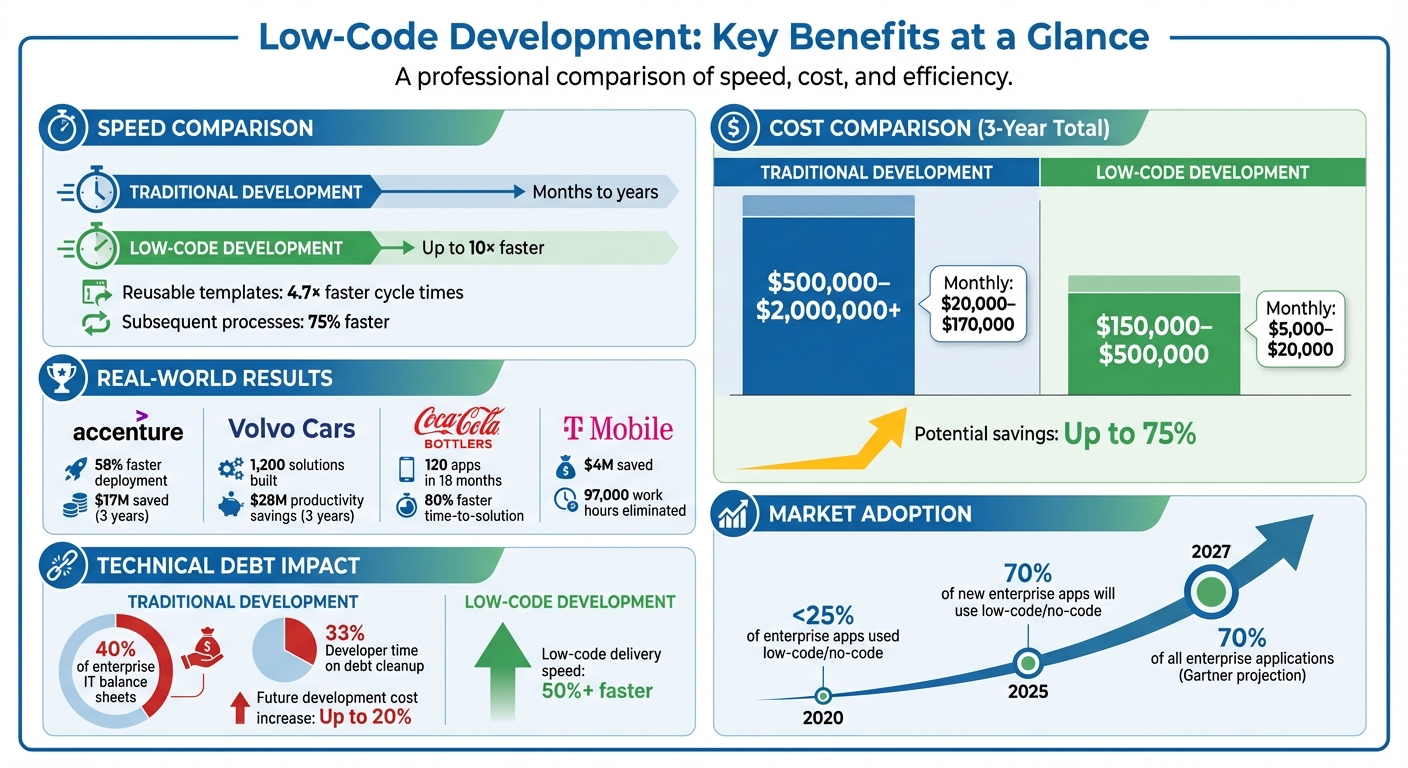
Low-Code vs Traditional Development: Cost and Time Comparison
Building a Foundation for Enterprise Agility and Process Optimization
sbb-itb-3a330bb
Challenge 1: Slow Time-to-Market
Traditional development cycles can stretch out for months or even years as teams work through coding, testing, and approval stages. By the time a product is ready, market conditions might have shifted, or competitors could have already gained an edge. This delay wastes resources and weakens a company's ability to stay competitive.
How Low-Code Speeds Up Development
Low-code platforms simplify development by replacing traditional coding with visual low-code and no-code platforms. These platforms allow teams to design workflows, user interfaces, and data models using drag-and-drop features. Instead of building everything from scratch, developers can tap into pre-built and pre-tested templates and components. This approach can make development up to 10 times faster, with reusable templates cutting cycle times by 4.7× and subsequent processes running 75% faster. Testing is also quicker since the platform's components are already tested, leaving developers to focus only on custom-built features.
"Low-code is devastatingly effective in specific situations... Internal tools, MVPs, dashboards can launch in weeks instead of months. The ten times speed improvement is real." - Garima Dua
Business Impact of Faster Development Cycles
The accelerated pace of development brings clear business benefits. For instance, in June 2024, Stone Coast, an independent fund administration firm, launched its first business application in just six weeks using Bizagi's low-code platform. That same month, Banco Popular managed to complete two operational processes with only two full-time staff members within six weeks. Similarly, SCOR UK developed a claims process from start to finish in the same timeframe. More recently, in September 2025, Pico Clinics created a centralized system for appointment scheduling, inventory management, and client records - progressing from concept to working prototype in just weeks.
"Faster time to market delivers significant business advantages: lowering costs through streamlined development cycles, unlocking innovation by freeing up resources, and enhancing agility to adapt to market shifts and seize opportunities." - Anthony Daly, Bizagi
Challenge 2: High Costs and Resource Constraints
Developing software the traditional way can be a financial strain. It typically costs between $20,000 and $170,000 per month, adding up to $500,000–$2,000,000+ over three years. In contrast, low-code solutions come in much lower, costing $5,000–$20,000 monthly or $150,000–$500,000 over three years. On top of this, the tech industry is staring at a projected shortage of 4 million skilled developers by 2025. With salaries for developers ranging from $80,000 to $150,000 per year, budgets are being stretched thin.
Cost Savings Through Citizen Developers
These high costs are pushing businesses to explore smarter alternatives. Low-code platforms are stepping in as a game-changer, enabling employees from departments like marketing, finance, and operations to create their own applications - no coding required. This approach reduces reliance on expensive development teams.
For example, in March 2026, Accenture leveraged Microsoft's Power Platform to cut deployment times for business applications by 58%, saving the company $17 million over three years. They achieved this by replacing outdated systems and avoiding traditional IT costs. Similarly, Volvo Cars trained over 500 employees as "makers", who collectively built 1,200 solutions, resulting in an estimated $28 million in productivity savings over three years.
"By enabling users with no coding experience to build solutions, businesses can cut down on costs, which result from hiring expensive development teams." - Sebastian Dewhurst, Founder and General Manager, EASA
Another success story comes from the Coca-Cola Bottlers' Association, which developed 120 applications in just 18 months using top no-code tools. This effort slashed time-to-solution for departmental needs by 80%. By empowering nontechnical staff, businesses can address challenges faster without waiting for IT resources, while also freeing up technical teams to focus on more demanding projects.
Reallocating Expert Resources for Complex Tasks
When citizen developers take on routine tasks, professional developers can shift their focus to more advanced work, such as complex system integrations, enterprise-level security, and architecture design. T-Mobile, for instance, used Microsoft's Power Platform to create the "Orbit App", which saved the company $4 million and 97,000 work hours. It also sped up request handling by 11 times and eliminated errors, reducing them from 7% to zero. With the platform automating infrastructure updates and maintenance, IT experts were free to tackle projects requiring specialized skills.
"Low-code and no-code platforms... will free up the IT team's time to focus on more complex matters that require their full attention." - Sebastian Dewhurst, Founder and General Manager, EASA
This resource reallocation lets businesses maximize the value of their highly skilled developers, directing their expertise toward challenges that demand their technical depth. Adopting low-code solutions is proving to be a practical way to overcome cost and resource challenges while boosting overall development efficiency.
Challenge 3: Managing Technical Debt
Technical debt doesn’t show up on financial statements, but its impact is felt everywhere - draining budgets, delaying projects, and leaving systems so fragile that even small issues can escalate into major outages. It’s estimated to make up about 40% of enterprise IT balance sheets, with 30% of CIOs admitting that over 20% of their budgets for new products end up addressing these problems instead. This debt often stems from rushed development practices - messy code, narrow integrations that don’t scale, or patchwork databases instead of clean, scalable architectures [18,21]. Common offenders include hard-coded values, repeated logic across modules, unclear naming conventions, and APIs with no documentation. The result? Developers spend roughly 33% of their time cleaning up technical debt instead of creating new features. Plus, future development costs can rise by up to 20%.
How Low-Code Reduces Technical Debt
Low-code platforms tackle technical debt head-on by swapping out thousands of lines of custom code for intuitive tools like data models, visual workflows, and prebuilt UI components [22,24]. These visual systems act as built-in documentation, giving developers immediate clarity without the headache of untangling cryptic code. On top of that, the platform itself manages critical tasks like security updates, infrastructure upgrades, and cross-platform compatibility, which lightens the load on IT teams. By using pre-tested, standardized components, low-code reduces bugs and integration headaches, helping organizations deliver services at least 50% faster. This streamlined approach not only cuts down on technical debt but also boosts scalability and speeds up development cycles.
"The platform itself becomes the debt prevention mechanism. When the default way to solve a process problem is to build a governed workflow rather than create another spreadsheet, the organization's overall debt trajectory shifts from accumulation to reduction." - Team Kissflow
The result? Easier maintenance and fewer headaches down the road.
Simpler Maintenance and Updates
Low-code platforms make maintaining and updating systems far less complicated. Instead of embarking on risky, years-long "rip-and-replace" projects, low-code overlays existing systems with a modern process layer. This layer absorbs manual workflows while leaving core records untouched, modernizing operations in weeks instead of years. Plus, these platforms tend to keep UX changes between versions minimal, which means developers spend less time reworking automated test scripts. When updates are needed, declarative designs make modifications straightforward - there’s no need to decipher overly complex implementation details. Every application built on the platform follows consistent architectural patterns and security protocols, reducing the risk of new "shadow IT" debt creeping in.
"Low code tools accelerate the development of applications... bypassing the code learning part, and therefore avoiding some typical coding mistakes." - Rosaria Silipo, Principal Data Scientist and Head of Evangelism, KNIME
Challenge 4: Limited Collaboration Between IT and Business Teams
When IT and business teams operate in separate silos, progress slows to a crawl. Low-code tools help bridge this divide by improving how these teams communicate. Business stakeholders often struggle to clearly define their needs, while developers work from incomplete or unclear requirements, resulting in solutions that don’t fully meet expectations. This misalignment leads to endless revisions, missed deadlines, and frustration on both sides. The core issue? Traditional development relies heavily on complex code that business users don’t understand, forcing teams to rely on lengthy documentation and clunky hand-offs, which only increase the chances of miscommunication.
Closing the Gap with User-Friendly Tools
Low-code platforms provide a shared digital workspace where IT and business teams can collaborate more effectively. Using visual models, drag-and-drop interfaces, and process flows, these platforms make business logic clear and accessible. Business users can kickstart applications with pre-designed templates for tasks like building CRMs or dashboards, while IT teams focus on advanced architecture, security, and customizations. In many cases, IT and business teams can even co-create applications in real time, ensuring that technical solutions align seamlessly with business objectives.
"Expert developers can focus their talents on infrastructure while business power users and citizen developers on the application layer, aligning resources according to strengths." - Harvard Business Review
The results are impressive. Organizations that embrace agile practices supported by collaborative tools often see 30% improvements in efficiency, customer satisfaction, and operational performance. Additionally, teams become five to ten times faster, driving innovation at an accelerated pace. By 2025, 70% of new enterprise applications will be built using low-code or no-code platforms, a huge leap from less than 25% in 2020. This shared workspace encourages faster feedback loops, which we’ll explore next.
Better Feedback Loops and Prototyping
Enhanced collaboration also brings real-time feedback into the development process. Traditional development often means waiting weeks for updates - stakeholders review static mockups, submit revisions, and then wait for developers to implement changes. Low-code platforms flip this approach. Instead of static wireframes, business teams can interact with functional, interactive screens early in the development process. Real-time previews allow stakeholders to test and refine changes instantly. Adjustments that used to take weeks can now be completed in hours, enabling teams to deliver more during each sprint - or even shorten sprint cycles.
This approach significantly reduces the risk of misunderstandings. By using visual workflows instead of burying business logic in thousands of lines of code, everyone can see exactly how the application will function. Low-code platforms can accelerate the launch of internal tools, MVPs, and dashboards by up to ten times compared to traditional methods. This speed creates more frequent feedback opportunities and minimizes rework, keeping projects on track and aligned with business goals.
How to Select the Right Low-Code Platform
Choosing a low-code platform that fits your needs is a critical step in maintaining agility and addressing development challenges effectively. With Gartner estimating that by 2027, 70% of new enterprise applications will rely on low-code or no-code technologies, the market is teeming with options. The trick is to focus on how a platform’s capabilities align with your unique requirements, rather than being swayed by lengthy feature lists.
Key Features to Look For
Start by defining your primary use case. Are you planning to build internal tools like HR portals or inventory dashboards? Or perhaps you need to automate workflows or develop customer-facing applications? Different platforms specialize in different areas. For teams with minimal technical expertise, prioritize platforms with drag-and-drop interfaces tailored for citizen developers. If your project demands advanced functionality, look for platforms that allow custom code extensions using JavaScript or server-side scripting.
Integration is another non-negotiable feature. A good platform should offer APIs and pre-built connectors to integrate seamlessly with your existing systems - whether it’s a legacy ERP, a CRM, or cloud services like AWS and Azure. Without strong integration capabilities, your applications could end up isolated and less effective.
Security and governance features are equally important. Opt for platforms that include role-based access control (RBAC), data encryption (both at rest and in transit), multi-factor authentication, and audit trails. If you’re in a regulated industry, ensure the platform complies with standards like GDPR or HIPAA. As ToolJet puts it:
"Establishing RBAC, a secrets policy, and deployment approvals in advance is far easier than retrofitting governance across multiple applications."
Scalability and performance should also be on your radar. Studies show that 25–30% of no-code projects are rewritten in custom code within two years due to performance issues. Before committing, test the platform under realistic conditions, check for cloud-native scaling (preferably Kubernetes), and assess the 3-year total cost of ownership. Remember, usage-based or per-user fees can add up quickly as your applications expand.
Once you’ve outlined your criteria, a structured comparison of platforms will help narrow down your options.
Using the Best Low Code & No Code Platforms Directory
The Best Low Code & No Code Platforms Directory (https://lowcodenocode.org) is a valuable resource for comparing top platforms across categories like analytics, automation, and web app development. Instead of researching dozens of vendors individually, this directory lets you evaluate platforms side-by-side based on features, pricing, and use cases. Developers can even submit their own tools, fostering an ecosystem that connects platform creators with potential users. Whether you’re looking for specific integration options or comparing enterprise pricing models, this tool simplifies the process of finding a platform that meets your development needs.
Conclusion
Low-code development directly addresses the agility challenges that often slow down modern organizations. By using pre-built components and automated deployment, it cuts development timelines from months to days. This approach also empowers non-technical users to create routine applications, which helps reduce costs and limits technical debt through automated updates. On top of that, it fosters collaboration by offering visual tools that bring IT and business teams together, enabling stakeholders to engage with working prototypes early in the process.
Experts emphasize the strategic importance of low-code platforms. For instance, Appian's low-code platform is often cited for its ability to handle complex enterprise workflows. As Gartner puts it, "Low-code is not a shortcut for simple apps, as it's a force multiplier for complex enterprise systems". Companies that see the most success with low-code aren’t replacing their development teams - they’re amplifying their productivity.
However, achieving these benefits depends on choosing the right platform. The best low-code solutions address key issues like integration, governance, and scalability. On the flip side, platforms with weak integration, poor governance tools, or limited scalability can end up creating more headaches than they solve. Look for platforms that integrate seamlessly with your existing systems, offer strong security certifications (like SOC 2 or HIPAA), and provide deployment flexibility to meet data sovereignty needs. Starting with internal projects, such as HR onboarding tools or operations dashboards, is a smart way to build trust within your organization before moving on to customer-facing applications.
To simplify the platform selection process, the Best Low Code & No Code Platforms Directory (https://lowcodenocode.org) is a valuable resource. It allows you to compare platforms side-by-side based on features, pricing, and use cases, saving you the trouble of researching dozens of vendors individually. With the right platform and governance in place, low-code can become a powerful tool for driving agility and long-term growth across your organization.
FAQs
When should we use low-code vs custom code?
Low-code platforms shine when it comes to speed, simplicity, and adaptability. They’re perfect for tasks like automating workflows, building prototypes, or developing small to medium-sized applications. If you need to respond quickly to shifting requirements, low-code can be a game-changer.
On the other hand, custom code becomes essential for projects that demand complex logic, high performance, or specialized integrations and compliance features. As businesses scale, they often transition from low-code to custom development to address the limitations of low-code platforms.
How can we prevent citizen development from leading to shadow IT?
To tackle the issue of shadow IT, consider using low-code platforms equipped with governance tools. These platforms let organizations establish policies, enforce compliance, and maintain oversight. Features like approval workflows and activity monitoring promote transparency and security while still giving citizen developers the freedom to create. This approach strikes a balance between flexibility and control, minimizing the risks of unauthorized or insecure tools while ensuring development aligns with company standards.
What should we test to ensure a low-code app will scale?
To make sure a low-code app can handle growth, it's crucial to evaluate a few key performance metrics. Start by testing response time to see how quickly the app performs under heavy usage. Next, measure throughput, which tracks the number of transactions processed within a specific time frame. Lastly, monitor CPU and memory usage to pinpoint potential bottlenecks.
It's also important to examine how well the platform adapts to increasing user demands, larger datasets, and more intricate workflows. Prioritize a modular design, leverage automation, and optimize resource management to keep performance steady and avoid scalability problems down the road.