Low-code platforms are reshaping how businesses build and improve software. By allowing teams to create applications up to 10x faster and cut costs by 50–70%, these tools empower both IT professionals and non-technical users to deliver results efficiently. With 80% of enterprises expected to adopt low-code by 2027, and 75% of large companies using multiple tools by 2026, the trend is clear: low-code is becoming a key driver for iterative development and faster innovation.
Key takeaways:
- Speed: Develop applications in days, not months.
- Cost Savings: Smaller teams, lower maintenance costs.
- Scalability: Modular designs and API-first strategies ensure systems grow with demand.
- Collaboration: Citizen developers and IT teams work together for better outcomes.
- Governance: Early platform selection and oversight reduce risks like shadow IT.
The article dives into planning scalable architectures, agile practices, iterative development, testing, and governance to maximize low-code’s potential. Whether you're streamlining internal processes or building complex systems, these strategies ensure success while minimizing technical debt.
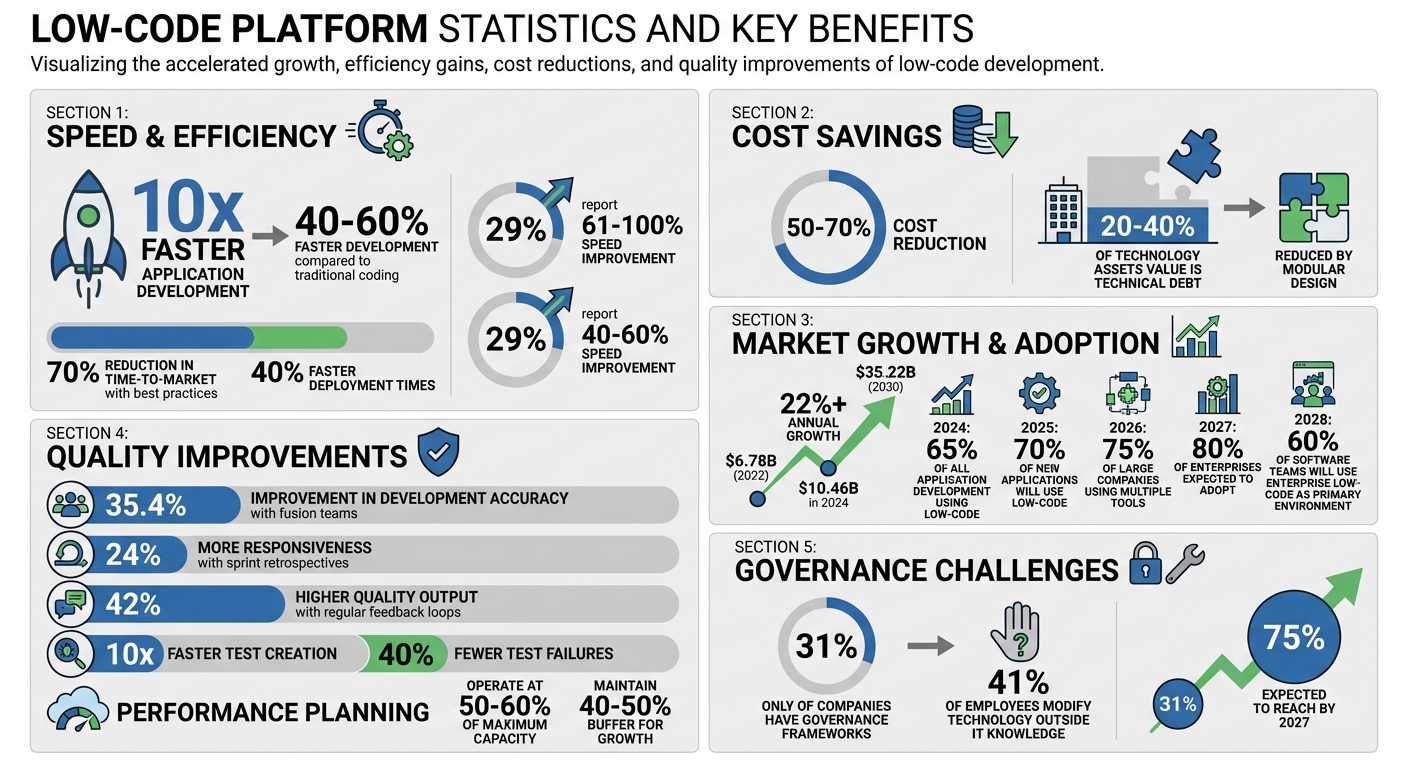
Low-Code Development Statistics and Benefits: Speed, Cost Savings, and Adoption Rates
Streamline and Automate Low Code Solutions for Process Improvement Using Power | Cla-Petra Omaku
sbb-itb-3a330bb
Planning and Architecture for Continuous Improvement
When designing systems, it’s smart to plan for growth and change right from the start. This helps reduce the need for constant overhauls down the road.
Modular architecture plays a key role in creating low-code systems that can evolve over time. Instead of building one massive, interconnected application, break it into smaller, independent components that communicate through clear APIs. This way, different parts of the system can scale individually. For example, if your customer portal sees a surge in traffic, you can scale that specific component without affecting the rest of the system. Considering that technical debt makes up 20% to 40% of the value of an organization’s technology assets, this kind of flexible design can significantly cut down on long-term maintenance headaches. This modular mindset also extends to planning your data strategy.
Building a Flexible Data Architecture
Your data architecture should allow for easy adaptation to shifting business needs. A key principle here is separation of concerns - keeping transactional data separate from analytical data. This ensures that running reports or queries won’t interfere with your core operations. Modern low-code platforms provide tools like sharding to distribute data across multiple instances and read replicas to handle heavy query loads without slowing down transactional processes.
An API-first integration strategy is another essential piece. By exposing system functionality through well-documented APIs, you create a stable layer that allows you to update or replace backend systems - whether it’s swapping databases, optimizing queries, or migrating to a new cloud provider - without disrupting other parts of your ecosystem.
Event-driven patterns further enhance system resilience. By using queues or event streams to manage integrations, you can prevent traffic spikes in one area from causing failures elsewhere. For instance, if your payment processor experiences delays, orders can be safely queued instead of timing out and triggering larger disruptions.
With a solid data architecture in place, the next step is planning for performance to ensure your systems scale smoothly.
Performance Planning for Scalable Applications
Planning for performance means preparing for growth, not just meeting today’s requirements. Aim to operate at 50% to 60% of your system’s maximum capacity, leaving a 40% to 50% buffer for unexpected demand spikes or organic growth. Without this buffer, organizations risk scrambling to keep up when user adoption suddenly accelerates.
The low-code market is booming - it hit $10.46 billion in 2024 and is growing at over 22% annually. By 2026, 75% of large enterprises are expected to use at least four low-code development platforms. This rapid growth means your platform and architecture choices need to handle exponential scaling, not just linear increases.
To future-proof your applications, design them to be independent of specific databases or cloud providers. This infrastructure abstraction reduces vendor lock-in and allows your platform to adopt new cloud features - like improved performance, better security, or expanded geographic reach - without requiring you to rewrite your code. It’s a practical way to stay agile as technology evolves. Exploring a curated collection of no-code and low-code resources can help teams identify the right tools for these modular architectures.
Implementing Iterative Development Cycles
Low-code platforms remove the need for traditional technical setups, speeding up development by 40% to 60%. This faster pace allows teams to quickly prototype, test, and refine solutions while sticking to short sprint cycles. These iterative cycles are essential for continuous improvement in digital transformation, enabling teams to make ongoing adjustments without requiring major rework.
By 2024, 65% of all application development was projected to use low-code tools. With this kind of acceleration, teams can create tighter feedback loops and adapt to changing requirements without completely disrupting their sprint plans.
Agile Methodologies and Low-Code Platforms
Using agile practices alongside low-code development requires rethinking how work is estimated. Tasks that once seemed complex - like creating a custom UI or setting up databases - now take just a few hours instead of days. This shift means teams need to adjust their velocity models to reflect the reduced time and effort.
The best way to integrate low-code into agile workflows is to treat it like any other user story in your Scrum or Kanban framework. This ensures transparency and prevents low-code development from becoming isolated. Many organizations are forming "fusion teams" that pair IT professionals with business subject matter experts (often called citizen developers). This collaboration boosts accuracy by 35.4%, as the people closest to the business problem are directly involved in creating the solution.
"Traditional development frameworks weren't designed for the iteration speed that agile demands." - Kissflow
This agile-low-code combination not only speeds up development but also allows for quick pivots when business needs shift. For example, in September 2025, Pico Clinics, a global leader in aesthetic medicine, worked with Stackdrop to centralize their operational systems using this approach. By combining agile principles with low-code tools, they went from concept to prototype in just weeks. When staff requested cross-location client record visibility mid-project, the team was able to design, test, and roll out the new functionality within days.
Continuous Integration and Deployment (CI/CD)
Low-code platforms also simplify deployment, building on the iterative improvements of agile practices. Modern platforms support continuous deployment by removing steps like compiling code and resolving dependencies. This allows releases to become part of the regular sprint process instead of requiring multi-hour coordination efforts. What was once a complex, time-consuming deployment process can now often be done with a single button click.
This streamlined process removes common roadblocks. Instead of spending time fixing infrastructure problems or resolving integration issues, teams can focus on business logic and refining requirements. The platform handles technical complexities, making it possible to deploy updates as frequently as the testing cycle allows.
Using Feedback Loops for Improvement
The visual nature of low-code platforms helps bridge the gap between technical and non-technical stakeholders. Instead of relying on lengthy requirement documents, teams can create functional prototypes in hours or days. This approach ensures alignment and avoids the common pitfall of building tools that employees ultimately don't use.
Teams that regularly conduct sprint retrospectives - a key feedback loop - see 24% more responsiveness and 42% higher quality in their output. Low-code platforms make it easy to incorporate feedback because changes happen through configuration rather than rewriting complex code. When users request changes, they can often be implemented within the same sprint without jeopardizing system stability.
Start with simple visual demos instead of rigid deliverables. Build something basic, gather feedback on what works and what needs improvement, and iterate quickly. Low-code platforms make this process less risky - you’re not dealing with layers of custom code that could break with every adjustment.
Testing, Monitoring, and Quality Assurance
Effective testing and monitoring are key to maintaining consistent improvement in low-code development.
Quality assurance in low-code environments demands a different approach compared to traditional development. One of the biggest strengths of low-code platforms is speed - testing can be created up to 10 times faster, with 40% fewer test failures. By adopting a "shift-left" strategy - integrating testing early in the development process - you can catch configuration errors and logic flaws before they escalate into costly problems.
Start testing during the early build stages. Focus automated testing on critical workflows like user registration, payment processing, and login sequences. These areas directly impact user trust and revenue, making them high-priority for ensuring reliability.
Automated Testing for Low-Code Applications
Modern low-code testing tools often incorporate AI to streamline test maintenance. For instance, when UI elements are updated - a common occurrence in iterative development - platforms with self-healing capabilities can automatically adjust test scripts. This minimizes the need for manual updates, addressing a task that traditionally consumed up to 45% of a tester's time.
Martin Schneider, a Delivery Manager at a company using BrowserStack, shared how automation transformed their process:
"Before BrowserStack, it took eight test engineers a whole day to test. Now it takes an hour. We can release daily if we wanted to".
To further simplify testing, modularize common sequences like login processes. Saving these as reusable modules reduces duplication and makes updates easier. Additionally, using meaningful element attributes such as data-testid or unique IDs enhances test stability, even when the interface changes.
While automated regression testing is essential, it’s not a complete solution. Pair it with exploratory testing by human testers to uncover usability issues and edge cases that scripts might miss. Low-code applications often rely on multiple third-party services, so robust API testing is equally critical to ensure secure and accurate data flow between systems.
Monitoring Application Performance and User Behavior
Testing alone isn’t enough - performance monitoring is equally important for validating builds in real time.
Monitoring should begin during development, not just after deployment. Real-time dashboards can track response times, error rates, and resource usage, providing instant feedback for optimizing performance before users are affected. Browser-driven monitoring is particularly useful, as it measures how quickly HTML, JavaScript, and CSS render for end users, offering insights into real-world performance.
Combining synthetic monitoring, real user monitoring, session recordings, and heatmaps helps identify friction points quickly. Research shows that slow performance leads to high abandonment rates, making performance tracking essential for retaining users.
To accurately identify performance issues, ensure your test environments mirror production as closely as possible. With low-code development projected to account for over 65% of all application development activity by 2025, strong monitoring practices will be critical to staying competitive.
Governance and Platform Selection
Selecting the right platform and setting up governance early are crucial steps to avoid security issues and technical debt. The global low-code market, valued at $6.78 billion in 2022, is expected to grow to $35.22 billion by 2030. This makes early decisions about platform selection and governance all the more critical.
Choosing the Right Low-Code Platform
The first step in platform selection is understanding your specific use case. For instance, if your focus is on quick front-end design, UI-centered tools are a good fit. Workflow automation platforms are ideal for streamlining internal processes, while execution-first platforms are better suited for handling complex backend logic and AI coordination.
Integration capabilities are equally important. The platform should seamlessly connect with existing systems like SAP, CRM, and ERP through strong APIs and connectors. A great example is DHL, which operates low-code applications in 17 languages across multiple countries as of September 2024. This highlights the importance of scalability and integration.
Security features should not be overlooked. Look for platforms offering role-based access control (RBAC), data encryption, audit trails, and compliance with standards such as HIPAA, SOC 2, or FedRAMP. For example, Ajit Singh, Chief Product Manager at Carat Lane, shared in March 2026 that his team uses the Kissflow platform to let business users design and test applications within a week. This shows how user-friendly platforms can also maintain strong security standards.
To simplify the evaluation process, resources like the Best Low Code & No Code Platforms Directory compare various tools, covering categories like analytics, automation, development, and web app building. This centralizes key information, helping teams find platforms that align with their architecture, skills, and goals.
When selecting a platform, align its capabilities with your team's expertise. Professional developers might need extensibility and architectural control, whereas citizen developers benefit from intuitive drag-and-drop interfaces. By 2028, 60% of software development teams are predicted to use enterprise low-code platforms as their primary development environment.
"The best low-code platform is the one that matches your architecture, your team's skill set, and your delivery goals".
Once the platform is chosen, governance becomes essential to manage risks and maintain compliance.
Establishing Governance for Low-Code Projects
Governance ensures both security and flexibility. However, only 31% of companies using low-code have established governance frameworks. Without proper oversight, shadow IT risks increase. Currently, 41% of employees modify technology outside of IT’s knowledge, and this figure is expected to reach 75% by 2027.
A risk-based tiering approach is a good starting point. Low-risk applications, such as internal task trackers, can operate with minimal oversight. In contrast, high-risk applications handling sensitive financial or personal data should undergo formal reviews. This balances the need for innovation with the requirement for control.
Creating a Center of Excellence (CoE) can help maintain platform standards, offer training, manage shared component libraries, and conduct regular application reviews. Additionally, forming "fusion teams" that combine IT professionals with business users has been shown to improve development accuracy by 35.4%.
To protect live systems while encouraging innovation, it’s important to separate development, testing, and production environments.
"Governance is not about slowing things down. It is about ensuring that the things being built are secure, compliant, maintainable, and aligned with organizational objectives".
A phased approach to governance can be particularly effective. Start with a Foundation phase to establish core policies and security baselines. Move to a Scaling phase to extend these practices across departments. Finally, reach an Optimization phase, using audit logs and metrics to fine-tune processes. This iterative approach allows organizations to adapt and improve low-code solutions as needs evolve.
"Start small. Think big. Scale fast".
Benefits and Summary
Low-code development offers a range of advantages, particularly when paired with effective practices. One of the standout benefits is speed. In a global survey, 29% of respondents reported that low-code development was 61–100% faster than traditional coding, and another 29% noted speed improvements between 40–60%. By adopting best practices, organizations can reduce time-to-market by as much as 70% compared to traditional methods.
Another major advantage is the empowerment of citizen developers. By 2025, it's estimated that 70% of new applications will be created using low-code platforms. This shift allows business experts to take on application development tasks, freeing IT teams to focus on strategic, high-value projects. Collaboration between business and IT teams not only improves efficiency but also enhances development accuracy. These gains ultimately lead to lower costs and reduced technical burdens.
Cost efficiency is another key benefit. Low-code reduces expenses by minimizing team sizes and requiring fewer hours from specialized developers for routine tasks. The use of standardized components and platform-managed infrastructure also helps prevent the buildup of fragile, legacy custom code. Companies that fully embrace low-code best practices can achieve 40% faster deployment times. As Gartner highlights:
"Low-code is not a shortcut for simple apps, as it's a force multiplier for complex enterprise systems".
Adaptability is another critical strength. Low-code allows for rapid iteration, enabling businesses to respond to market shifts or internal changes almost in real time. Centralized data access and integrated analytics provide a clear view of operations, enabling smarter, data-driven decisions.
However, success with low-code requires a disciplined approach. As ToolJet emphasizes:
"The organizations seeing the greatest ROI from low-code are not those that replaced their development teams - they're the ones that used low-code to amplify what their teams could deliver".
Starting with noncritical projects, establishing governance early, and maintaining IT oversight are essential steps to ensure low-code becomes a sustainable tool for continuous improvement rather than a source of technical debt. With these strategies, organizations can adapt and thrive in a rapidly evolving digital world.
For more insights and platform comparisons, check out the Best Low Code & No Code Platforms Directory.
FAQs
How do I choose the right low-code platform for my use case?
To begin, pinpoint your exact needs and objectives - whether it's automating processes, developing apps, or something else entirely. Collaborate with key team members to gather their insights and requirements. When evaluating platforms, focus on factors like features, scalability, integration capabilities, security measures, and overall cost.
Start small by testing the platform with pilot projects. This will help you gauge its usability and make any necessary adjustments before committing fully. Look for platforms that seamlessly connect with your current systems, allow for ongoing improvements, and can grow with your organization over time.
How can we prevent technical debt while iterating quickly with low-code?
To keep technical debt in check during low-code development, prioritize clear governance practices and implement version control to maintain consistency across your projects. Make scalability a core part of your design process to reduce the need for future rework. Begin with well-defined goals and workflows that align with your broader objectives.
Adopt a modular design approach to make updates easier and ensure your applications stay up-to-date. Striking a balance between rapid development and careful planning, along with a focus on scalable architecture, is key to managing technical debt successfully.
What governance is needed to avoid shadow IT with citizen developers?
Preventing shadow IT starts with laying down a solid governance framework. This means creating clear policies, implementing role-based access controls, and setting compliance standards that everyone in the organization understands and follows.
Tracking accountability is just as important. Using audit trails to monitor changes ensures that every action can be traced back to its source, reducing the chances of unauthorized activity slipping through the cracks.
To stay ahead of potential security and compliance issues, automation tools can be a game-changer. For example, AI-powered systems can keep an eye on security and compliance in real-time, flagging risks before they escalate.
Another effective strategy is setting up a Center of Excellence (CoE) or a similar oversight group. These bodies help ensure that citizen development aligns with the organization's standards. By doing so, you can minimize risks like data silos or security vulnerabilities while maintaining a cohesive approach to IT management.