When deciding between REST and gRPC for application communication, the choice depends on your specific needs. REST is widely used for public-facing APIs due to its simplicity, browser compatibility, and ease of debugging with JSON. Meanwhile, gRPC offers better performance, lower latency, and advanced features like streaming, making it ideal for internal microservices and performance-critical systems.
Key Highlights:
- REST: Resource-based, uses HTTP/1.1 and JSON. Great for public APIs, browser support, and caching.
- gRPC: Service-based, uses HTTP/2 and Protocol Buffers. Perfect for internal systems, high-speed communication, and streaming.
Quick Comparison
| Feature | REST | gRPC |
|---|---|---|
| Architecture | Resource-oriented | Service-oriented |
| Protocol | HTTP/1.1 | HTTP/2 |
| Data Format | JSON (human-readable) | Protocol Buffers (binary) |
| Performance | Lower latency, JSON overhead | High throughput, compact payloads |
| Streaming | Not supported | Supports 4 patterns of streaming |
| Caching | Built-in HTTP caching | Requires custom solutions |
| Browser Support | Native | Needs gRPC-Web proxy |
| Tooling | Simple (Postman, curl) | Specialized (protoc, grpcurl) |
For public APIs, REST's flexibility and ease of use make it a reliable choice, especially when integrated with no-code and low-code tools for rapid development. For internal services where performance matters, gRPC's efficiency and advanced capabilities stand out. Many modern systems combine both: REST for external clients and gRPC for internal microservices.
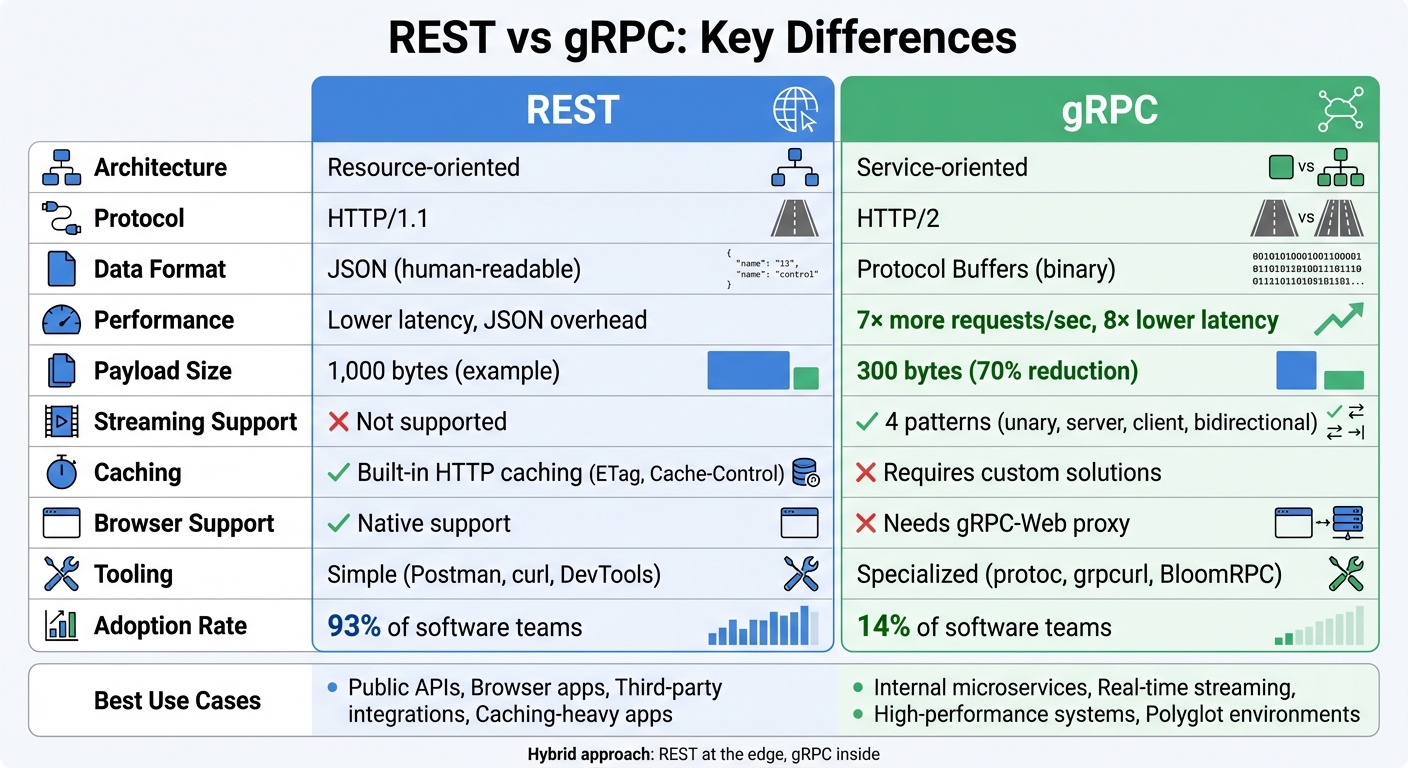
REST vs gRPC: Complete Feature Comparison Chart
REST vs gRPC in Microservices | Which One Should You Use? (Explained Clearly)
sbb-itb-3a330bb
How REST and gRPC Differ in Architecture
REST and gRPC take fundamentally different approaches to communication. REST is resource-oriented, where endpoints represent entities like /users or /orders. gRPC, on the other hand, is service-oriented, focusing on method calls such as PlaceOrder() or GetUserProfile(). This distinction shapes how data is transported and how services interact. Let’s break down how these differences play out in protocols, communication styles, and code generation.
Protocols and Data Formats
REST typically uses HTTP/1.1 with JSON, which is easy to read but can be quite bulky. gRPC adopts HTTP/2 and Protocol Buffers (Protobuf), a compact binary format that significantly improves efficiency. For example, a 1,000-byte JSON payload can shrink to just 300 bytes with Protobuf - a 70% reduction. HTTP/2 also supports multiplexing, allowing multiple requests to share a single connection, and uses HPACK compression to cut header sizes by 80–90%.
Performance benchmarks highlight gRPC’s advantages. NGINX tests show gRPC can handle nearly 7 times more requests per second than REST and reduce latency by 8×. Similarly, Salesforce has reported 5–8 times less overhead for comparable payloads.
However, this efficiency comes with a trade-off. REST’s JSON is widely supported by browsers, command-line tools, and debugging software. In contrast, gRPC’s binary format requires specialized tools and depends on a gRPC-Web proxy to work natively in browsers.
Communication Patterns
REST operates within a traditional request-response model: the client sends a request and waits for a reply. gRPC, however, offers more flexibility with four communication styles:
- Unary: One request, one response.
- Server streaming: One request, multiple responses.
- Client streaming: Multiple requests, one response.
- Bidirectional streaming: Continuous two-way data flow.
This flexibility makes gRPC ideal for real-time applications, such as live dashboards, chat systems, or IoT telemetry. Additionally, HTTP/2’s multiplexing prevents head-of-line blocking, ensuring slow requests don’t hold up others.
Coupling and Code Generation
REST is loosely coupled, relying on URLs and data formats. While documentation like OpenAPI specs is helpful, it’s optional and often lags behind actual implementations. In contrast, gRPC enforces tight coupling: both client and server must share the same .proto file, which defines the data structures and method signatures. Using the protoc compiler, developers can auto-generate type-safe client and server code in multiple languages.
As OneUptime puts it, "The contract IS the implementation." This tight coupling ensures compile-time safety. For example, if a client tries to call a non-existent method or uses an incorrect data type, the code won’t compile.
"REST is loosely coupled, which means the client and the server do not need to know anything about the other's implementation. gRPC is tightly coupled, which means the client and server must have access to the same proto file. Any updates to the file require updates in both the server and the client."
– AWS
For public APIs that need to serve a variety of clients (like mobile apps, web browsers, and third-party developers), REST’s flexibility is a major strength. On the other hand, for internal microservices where both ends are under controlled development, gRPC’s strict contract ensures integration issues are caught early, long before they reach production.
Performance and Scalability
When it comes to performance, the numbers make a strong case. gRPC consistently delivers better speed and efficiency compared to REST. However, scalability isn't just about throughput - it also hinges on factors like caching and the underlying infrastructure.
Latency and Throughput
gRPC's use of binary serialization and HTTP/2 multiplexing leads to notable performance improvements. According to NGINX benchmarks, gRPC processed almost 7 times more requests per second than REST, while reducing latency by a factor of 8. Similarly, Google's tests revealed that gRPC could lower latency by up to 60% in certain scenarios. These gains are largely due to Protocol Buffers, which produce payloads that are 70–75% smaller than JSON, and HTTP/2's HPACK compression, which reduces header sizes by 80–90%.
Real-world examples highlight these benefits. In early 2024, a competitive gaming company transitioned its matchmaking service from REST to gRPC to manage peak traffic of 10,000 requests per second. This switch led to a 40% reduction in p99 latency and a 30% decrease in server usage, cutting annual cloud costs by about $120,000. Similarly, a smart home IoT startup reduced its total data usage across devices by 78% after adopting gRPC.
That said, gRPC's reliance on persistent HTTP/2 connections can complicate traffic distribution. Traditional Layer 4 load balancers, which focus on long-lived connections, may struggle to evenly distribute the load. To address this, gRPC scaling often requires Layer 7 load balancers or service meshes like Istio or Linkerd. While gRPC shines in raw speed, its ability to scale effectively also depends on how caching demands are managed.
Caching and Scalability
While gRPC dominates in speed, REST has a clear edge when it comes to caching, which plays a vital role in scalability for data-heavy applications. REST's stateless architecture and standard HTTP methods allow it to seamlessly integrate with CDNs and browser caching. Features like ETag, Cache-Control, and Last-Modified headers enable advanced caching strategies that can significantly reduce server load, especially for applications with frequent reads and infrequent updates.
On the other hand, gRPC's binary payloads and reliance on POST requests make standard HTTP caching impractical. While custom caching layers can be implemented, they require additional infrastructure and lack the widespread support REST enjoys. For APIs that serve web browsers or mobile apps with repetitive read patterns, REST's built-in caching capabilities often make it the better choice for scalability.
Ultimately, the decision depends on your specific needs. For internal microservices where low latency and high throughput are critical, gRPC's speed advantage is hard to ignore. However, for public-facing APIs that benefit from caching, REST's compatibility with existing caching systems can deliver better scalability in the long run.
When to Use REST vs gRPC
Choosing between REST and gRPC isn't about deciding which one is inherently better - it’s about finding the right fit for your specific use case. As the Boundev team puts it:
"The question isn't 'which is better?' It's 'which is better for this specific communication channel?'"
Best Use Cases for REST
REST is the go-to choice for public-facing APIs. Its universal compatibility ensures that external developers can easily work with it, as every browser supports REST natively. Tools like curl or Postman allow developers to test endpoints without requiring any specialized setup.
REST also works seamlessly with browser-based applications. Since browsers lack the control over HTTP/2 features that gRPC relies on, using gRPC often requires an extra proxy layer like gRPC-Web. REST avoids this extra complexity. Additionally, its human-readable JSON format makes debugging straightforward - payloads can be inspected directly in browser developer tools.
Caching is another area where REST shines. For applications that serve data with low update frequency - like product catalogs, blog posts, or user profiles - REST’s support for HTTP caching headers (e.g., ETag and Cache-Control) can reduce server load significantly. Ronald Frey from Phreesite sums it up well:
"If humans will debug this often, REST gets the edge. If machines will call this at scale, gRPC gets the edge."
While REST has its strengths, gRPC is better suited for scenarios where internal performance takes priority.
Best Use Cases for gRPC
gRPC is built for performance, making it ideal for high-speed communication between internal microservices where you control both ends. Its use of binary Protocol Buffers and HTTP/2 multiplexing ensures low latency and high throughput, which are crucial for demanding applications.
Real-time streaming is where gRPC truly stands out. Unlike REST's single request–response model, gRPC supports four streaming patterns: unary, server-streaming, client-streaming, and bidirectional streaming. This makes it perfect for applications like chat platforms, live video streaming, or IoT communications where continuous data flow is required. Moreover, in polyglot environments, gRPC’s .proto files serve as a single source of truth, automatically generating type-safe client and server code in multiple languages.
Gints Dreimanis from Cerbos highlights gRPC's performance benefits:
"Authorization is in the critical path of every request, and therefore needs to be as fast as possible... Cerbos picked gRPC for performance reasons."
An emerging pattern since 2026 has been the hybrid approach - using REST for public APIs and browser clients while employing gRPC for internal service mesh communication. This strategy combines REST’s simplicity and accessibility with gRPC’s performance advantages, reinforcing the idea of tailoring the protocol to the specific needs of each communication channel.
Implementation Complexity
REST keeps things straightforward by using standard HTTP methods and JSON, making it easy to test with tools like curl and Postman. There’s no need for compilers or code generation - just send a request and read the plain-text response. This simplicity is a big reason why, according to Postman's 2025 State of the API Report, 93% of software teams use REST APIs, compared to just 14% using gRPC.
gRPC, on the other hand, comes with its own setup requirements that can affect your workflow. It follows a contract-first approach, where services are defined in .proto files, and type-safe code is generated using protoc. Its binary format means payloads aren’t human-readable, so debugging requires specialized tools like grpcurl or BloomRPC.
Setup and Tooling
REST has a well-established ecosystem. Tools like OpenAPI (formerly Swagger) make documentation optional but accessible, CDNs handle caching effortlessly, and browser DevTools allow for live request inspection. Because everything works natively in browsers, REST is the go-to choice for public-facing APIs.
gRPC’s tooling is more niche. Since browsers don’t natively support the HTTP/2 features that gRPC relies on, you’ll need to introduce a proxy layer like Envoy and use gRPC-Web for JavaScript clients. This adds a layer of complexity that REST doesn’t require.
Here’s a quick comparison of tooling differences:
| Feature | REST Implementation | gRPC Implementation |
|---|---|---|
| Primary Tooling | Postman, curl, Browser DevTools | protoc, grpcurl, gRPC-Web proxy |
| Contract Definition | Optional (OpenAPI/Swagger) | Required (.proto files) |
| Code Generation | Manual or third-party tools | Native/Built-in |
| Browser Support | Native | Requires gRPC-Web + Proxy |
| Learning Curve | Low (uses standard HTTP/JSON) | Moderate (requires learning Protobuf) |
Language and Platform Support
REST’s compatibility is hard to beat - it works on any platform that can make HTTP requests. This makes it an excellent choice when you need to integrate with third-party services or work across varied technology stacks.
gRPC, meanwhile, offers official support for many major languages, including C++, Java, Python, Go, Ruby, C#, Node.js, and Dart. However, languages like Rust or Elixir don’t have official support, which can increase the effort required to implement. If you’re working within a controlled stack for internal systems, this limitation might not be a dealbreaker, but it’s something to keep in mind when choosing a solution.
Maintenance in Microservices
One challenge with REST is the potential for documentation to fall out of sync with the API itself. Teams often rely on discipline or tools like OpenAPI to maintain alignment, but this requires consistent effort.
gRPC simplifies this with automated code generation. The .proto file acts as a single source of truth, ensuring type safety across different languages through the compiler. This reduces the risk of integration errors that can happen in loosely coupled REST systems. In fact, a migration to gRPC has been shown to deliver a 7× latency improvement.
The Boundev team sums up the trade-offs well:
"REST remains the best choice for public APIs because of its simplicity, browser compatibility, and universal tooling support. gRPC is the right choice for internal microservice communication where performance, strong contracts, and streaming capabilities justify the additional tooling complexity."
For teams managing complex microservices, the upfront investment in gRPC’s tooling often pays off with fewer runtime errors and reduced maintenance headaches. These complexities directly influence how scalable and manageable a solution is within a microservices architecture.
Choosing Between REST and gRPC
The choice between REST and gRPC depends on what your project needs. REST is a go-to option when you require broad compatibility, easier debugging, and seamless integration with third-party services. On the other hand, gRPC is ideal for situations where performance, bandwidth efficiency, and type-safe communication are top priorities.
REST's straightforward nature and universal compatibility make it a reliable choice, especially for public-facing APIs or scenarios that require browser support. In contrast, gRPC thrives in controlled environments, particularly for internal microservices. Its performance edge - often 7 to 10 times faster than REST with JSON - justifies its added complexity when speed and efficiency are essential.
For systems that demand high performance, such as those requiring latency under 50ms or handling high-throughput data pipelines, gRPC's binary serialization and HTTP/2 multiplexing can make a noticeable difference. These features allow gRPC to process requests faster and use bandwidth more efficiently.
Interestingly, many modern systems blend both protocols for the best of both worlds. A common approach is "REST at the edge, gRPC inside". This setup uses an API gateway, like Envoy or Kong, to convert external REST requests into internal gRPC calls. It ensures compatibility with public clients while maintaining gRPC's efficiency for internal service-to-service communication.
If you're uncertain where to start, begin with REST. You can always introduce gRPC endpoints later for calls that require enhanced performance. This strategy allows you to balance simplicity and efficiency as your system evolves.
FAQs
How hard is it to migrate from REST to gRPC?
Migrating from REST to gRPC doesn't have to be overwhelming - it can actually be tackled step by step. Tools like grpc-gateway make this easier by supporting both REST and gRPC protocols simultaneously. This allows you to roll out changes gradually while keeping everything compatible with existing systems.
The level of complexity involved will depend on your current infrastructure and how integrated your systems are. It's true that setting up gRPC can feel more involved at first, especially with the need to work with HTTP/2 and Protocol Buffers. However, with proper planning, the performance improvements it offers can make the effort worthwhile.
Can I use gRPC directly in a web browser?
No, you can’t use gRPC directly in web browsers. Why? Because browsers only support HTTP/1.1 by default, while gRPC relies on HTTP/2. Plus, there are some browser restrictions that make the gRPC protocol a poor fit.
The solution? gRPC-Web. It acts as a compatibility layer, allowing browsers to communicate with gRPC servers seamlessly.
How do I handle caching with gRPC?
Caching with gRPC works differently compared to REST APIs. Unlike REST, gRPC doesn’t come with built-in support for HTTP caching headers like ETag or Cache-Control. This means caching has to be handled directly within your application. To address this, you can create custom cache headers or develop cache invalidation strategies tailored to your service logic. These approaches ensure you can manage caching effectively despite the lack of native support.