Robotic Process Automation (RPA) is transforming how businesses handle repetitive tasks, offering major time and cost savings, often achieved through low-code platforms. But while companies benefit from faster processes and lower expenses, automation raises ethical concerns like job displacement and worker insecurity. The challenge? Implement RPA responsibly to balance efficiency with workforce well-being.
Key insights:
- Efficiency Gains: RPA can cut task time by up to 60% and reduce errors, freeing employees for more strategic work.
- Cost Savings: Companies report a 20–27% drop in operational costs and ROI as high as 250% within months.
- Job Risks: Up to 94% of U.S. accounting jobs could be impacted, with low-wage roles most vulnerable.
- Ethical Implementation: Transparent communication, retraining programs, and human oversight are critical.
The future of automation lies in using RPA to complement human roles, not replace them. This approach protects jobs, supports employee growth, and ensures businesses thrive in an automated world.
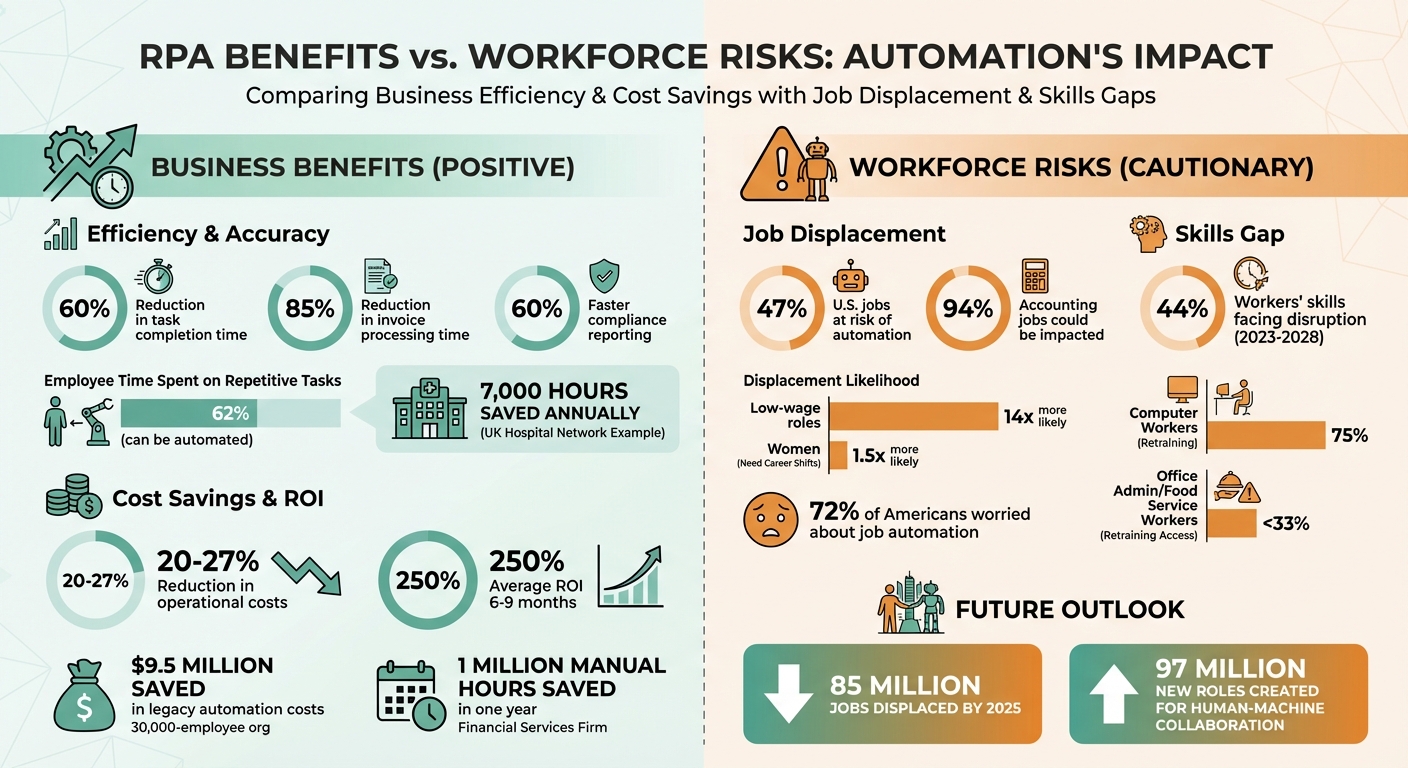
RPA Impact Statistics: Efficiency Gains vs Workforce Risks
AI Driven Future Workforce Evolution In The Automation Era
sbb-itb-3a330bb
Business Benefits of RPA
While RPA offers impressive operational advantages, it's important to weigh these benefits alongside ethical considerations.
Better Efficiency and Accuracy
RPA bots excel at handling repetitive tasks like data entry, form filling, and file transfers by imitating human actions on a screen. Unlike humans, these bots work around the clock, completing hours-long tasks in just minutes. For instance, a hospital network in the UK managed to save 7,000 hours annually by automating administrative tasks, while a financial services company completed nine years' worth of mortgage quality checks in only two weeks.
Accuracy is another area where RPA shines. By strictly following pre-set instructions, bots eliminate errors caused by fatigue or monotony. In practical terms, companies using RPA for invoice processing have seen an 85% reduction in processing time, and compliance reporting is now 60% faster and more precise. Considering that employees typically spend about 62% of their time on repetitive tasks, automation allows them to shift their focus to more strategic, value-driven work. These low-code platform insights and efficiency improvements not only cut costs but also make operations scalable.
Lower Costs and Easier Scaling
The financial appeal of RPA lies in its ability to deliver consistent results at a fraction of the cost of human labor. Many organizations report a 20–27% reduction in operational expenses and average a 250% return on investment within six to nine months. For example, one financial services firm saved 1 million manual hours in a single year, while another found their RPA solution to be $1 million cheaper than their previous automation platform.
Scaling is also more straightforward with RPA. Instead of hiring and training new employees, businesses can simply replicate digital workers to meet increased demand. This flexibility is particularly useful during seasonal surges, such as holiday order processing, without the delays and costs of recruitment. Additionally, a 30,000-employee organization cut $9.5 million in legacy automation costs by upgrading to more efficient RPA tools. By reducing expenses and reallocating human talent to more impactful roles, RPA supports both cost savings and strategic growth.
Ethical Issues: Job Loss and Worker Security
While RPA brings efficiency and cost savings, it also raises serious ethical questions about its impact on workers. The real challenge isn’t whether automation should happen - it’s finding ways to implement it without sidelining employees.
Risks of Job Replacement
RPA primarily targets rule-based tasks, making entry-level and front-line jobs particularly vulnerable. Positions like data entry clerks, payroll processors, and basic customer service representatives are at the greatest risk because their work follows predictable patterns that bots can replicate. Research shows that low-wage roles are up to 14 times more likely to be displaced than higher-paying jobs. Additionally, women face a disproportionate impact, being 1.5 times more likely than men to need career shifts due to automation trends.
The consequences go beyond financial loss. Job displacement caused by automation can erode a person’s sense of professional identity and lead to mental health issues like anxiety and depression. For instance, when IBM announced in May 2023 that it could replace around 7,800 jobs with AI and RPA, it demonstrated how quickly automation can transition from a theoretical concern to a practical reality. Oxford University researchers have estimated that 47% of jobs in the United States are at risk of automation, and a striking 72% of Americans are worried about a future where robots and computers take over many human roles.
Adding to the complexity is the practice of "AI-washing," where companies attribute layoffs to automation when the real drivers might be financial pressures, debt, or over-hiring during the pandemic. For example, in January 2026, only 7% of the 108,435 recorded layoffs were directly tied to AI. This kind of misrepresentation not only misleads workers but also undermines trust among investors. These risks highlight the pressing need for robust retraining programs to prepare workers for a changing job landscape.
Challenges in Worker Retraining
As automation displaces more workers, the lack of effective retraining programs becomes a critical issue. Workers in lower-wage roles face the highest risk of displacement but often have the least access to upskilling opportunities. While 75% of workers in computer-related fields actively engage in retraining, less than 33% of those in sectors like office administration, food service, and transportation have similar opportunities.
The World Economic Forum predicts that 44% of workers’ skills will face disruption between 2023 and 2028, yet many companies are unprepared to bridge this gap. Effective retraining requires more than generic online courses - it involves identifying future skill requirements, providing focused coaching, and allowing employees time to adjust. Psychological barriers also play a role; workers who’ve spent years mastering manual tasks may find the idea of learning technical skills like RPA development or data analysis daunting. Without sufficient funding and executive support, retraining programs risk becoming superficial efforts rather than meaningful solutions.
How to Implement RPA Ethically
Deploying RPA doesn’t have to be a trade-off between improving efficiency and supporting employees. Companies can achieve both by following a few key principles.
Clear Communication with Staff
Start by addressing the workforce early and openly to avoid misinformation. Clearly share which departments and tasks will be affected, how roles might change, and the project timeline. This message should come directly from senior leadership to show genuine commitment.
"Employees will respond to a lack of information about a project by filling in their own expectations, often a worst-case scenario, and then that topic becomes the unproductive distraction in their day."
– Aharon Yoki, Assistant Professor, University of South Florida
Frame automation as a way to enhance jobs rather than replace them. For example, when Notting Hill Genesis introduced RPA, Chief Executive Kate Davies emphasized that automating repetitive, mundane tasks would allow employees to focus on more engaging work, ultimately boosting job satisfaction. To keep staff informed, set a clear notification date during the planning phase and create feedback channels, like surveys or listening sessions, to address concerns as they arise. Transparent communication like this sets the stage for effective training and smooth integration of automation.
Training and Development Programs
Generic online training sessions won’t cut it. Start by building an automation competency matrix to identify where skill gaps exist within your team. From there, create tailored learning plans that connect RPA tools directly to employees’ daily responsibilities.
One effective approach is the "train the trainer" model. Select internal experts to act as instructors, creating a scalable learning system for the entire organization. As UiPath Program Manager Irina Lazar pointed out, “Investing in the development of employees is less expensive than rehiring and retraining new employees.” Training should focus on helping employees transition from repetitive tasks to higher-value roles, such as managing RPA systems or analyzing data. Using low-code and no-code platforms with simple, drag-and-drop interfaces can also reduce technical hurdles for employees.
Combining Automation with Human Control
For ethical automation, ensure human oversight at critical decision points, especially for high-stakes outcomes or when the system’s confidence level is low. Develop clear override protocols that guide when employees should step in to review or adjust automated decisions.
Establish a centralized Center of Excellence with representatives from IT, HR, and Legal to review automation workflows before they go live. Leverage tools like LIME or SHAP to make automated decisions transparent and easy to audit. Use real-time dashboards and conduct regular audits to catch biases or errors that may require human correction. Encouraging employees to become RPA champions - team members who act as liaisons between bots and the workforce - can lead to smoother implementation and better team morale. These steps help ensure robust oversight and minimize risks tied to automation.
Oversight and Responsibility in Automation
Creating Oversight Structures
To ensure ethical and effective implementation of RPA (Robotic Process Automation), establishing strong oversight structures is essential. A 2016 study found that 30–50% of RPA initiatives failed, with governance issues being a major culprit. By 2018, while 53% of businesses had embarked on automation journeys, only 3% had managed to scale their digital workforce across the enterprise.
One effective approach is creating a centralized Center of Excellence to oversee RPA initiatives. This center operates across strategic, management, and operational levels, focusing on:
- Defining business goals and KPIs
- Assigning clear roles to process owners and bot developers
- Managing the bot lifecycle, from development to ongoing maintenance
"RPA governance supports effective IT business alignment and the selection and use of suitable tools and processes to confidently manage both individual RPA projects and the enterprise-wide automation landscape." – Mulesoft
Another critical step is forming Automation Ethics Committees. These committees, composed of technical experts, ethicists, HR representatives, legal advisors, and employee stakeholders, review automated systems to address concerns like bias, fairness, and unintended consequences before deployment. Appointing senior leaders as "AI Owners" further ensures that automation systems align with company values and legal requirements. This clear chain of responsibility helps eliminate "accountability gaps", where no single party takes ownership of the outcomes. By putting these governance structures in place, companies can reduce project failures and uphold ethical standards while balancing efficiency with workforce security.
Identifying and Reducing Risks
With governance frameworks established, businesses can tackle the operational and ethical risks tied to automation. Ethical oversight should focus on five key areas: operational failures, financial errors, regulatory non-compliance, organizational impacts, and technological vulnerabilities.
Before deploying automated systems, conduct Algorithmic Impact Assessments to evaluate their purpose, data quality, potential for discriminatory outcomes, and privacy implications. For example, apply the "four-fifths rule" to test for bias: the selection rate for any protected group should be at least 80% of the rate for the highest-performing group. Bots should also be tested in controlled environments prior to deployment, and regular bias audits can help uncover "proxy discrimination" - where variables like zip codes inadvertently reflect protected characteristics such as race.
"Segregation of duties from an internal control perspective becomes less about what the bot has access to, and more about what the human directing the inputs to the bot's activities has access or authority to do." – Ethics Board
Internal controls should shift focus to the authority of individuals directing bot inputs rather than just bot access itself. Continuous monitoring through real-time dashboards, performance metrics, and error logs is vital for maintaining stability and detecting algorithmic bias. Incident response protocols are also necessary to investigate and address harm caused by automation failures or biased outcomes.
The rise of low-code and no-code tools, which allow non-IT staff to create bots, adds another layer of complexity. These tools can lead to "islands of innovation" without centralized ethical oversight or security controls. This makes robust monitoring and governance systems even more essential to ensure accountability and safety.
Conclusion
As industries embrace automation, the path forward must blend efficiency with fairness in workforce practices. Robotic Process Automation (RPA) offers clear benefits - streamlined operations, reduced costs, and the ability to scale rapidly. With its growing adoption, automation has become essential for maintaining a competitive edge.
The numbers paint a complex picture: while 85 million jobs might be displaced by 2025, around 97 million new roles are expected to emerge, tailored to human–machine collaboration. This highlights an urgent need for companies to act. The goal should be to leverage RPA in a way that complements human talent rather than replaces it. Instead of focusing solely on cutting headcount, businesses should prioritize optimizing tasks - automating repetitive work so employees can transition into roles that are more engaging and skill-driven. Achieving this requires actionable steps, such as reskilling initiatives, open communication about automation strategies, and phased transitions that allow employees to adapt.
"The businesses that will thrive in an increasingly automated world are those that recognize ethical considerations as integral to technological excellence, not external constraints on it." – Autonoly Team
Ethical automation isn't just about doing the right thing - it’s a smart business move. It safeguards brand reputation, ensures compliance with regulations, and attracts top talent at a time when 72% of Americans express concern about a future dominated by robots and computers taking over jobs. The companies that succeed will be those that treat RPA as a tool to enhance human potential, not replace it.
FAQs
Which jobs are most at risk from RPA?
Jobs that rely on repetitive, rule-based tasks are particularly vulnerable to Robotic Process Automation (RPA). These include roles like data entry and calendar management in administrative settings, assembly line work in manufacturing, and truck driving in transportation. Industries such as finance, customer service, and data processing are also at risk. RPA thrives in automating routine, high-volume tasks, making processes like invoice processing and report generation more efficient.
How can companies retrain employees for roles after automation?
Companies can support their employees by offering reskilling and upskilling programs that prepare them for roles shaped by automation. These programs focus on teaching the skills needed for new positions and promoting a mindset of ongoing learning. By taking these steps, businesses can ease concerns about job displacement, help their teams adapt to technological shifts, and create a more secure and engaged workforce.
What governance should be in place to keep RPA ethical and accountable?
Organizations aiming to maintain ethical and accountable RPA practices need to adopt governance frameworks rooted in transparency, responsibility, and societal benefit. A few critical steps include establishing auditable decision-making processes to ensure accountability, implementing role-based controls to manage access and responsibilities, and conducting continuous monitoring to identify and address biases or errors in the system.
Beyond technical measures, businesses should also focus on the human side of automation. For example, they must tackle workforce challenges, such as job displacement, by prioritizing worker upskilling programs to help employees adapt to new roles. Lastly, staying compliant with data privacy and security standards is non-negotiable. This not only protects sensitive information but also builds trust in the organization's use of RPA technologies.