API mocking is a game-changer for microservices development. It simplifies testing, reduces costs, and speeds up workflows by simulating API endpoints without relying on live services. This allows teams to work in parallel, test edge cases like server errors or latency, and ensure reliable CI/CD pipelines.
Key Takeaways:
- Faster Development: Mock endpoints can cut CI/CD test times by up to 300%.
- Cost Savings: Avoid unnecessary third-party API calls - one fintech company saved $15,000 annually.
- Resilience Testing: Safely simulate failures like 5xx errors, rate limits, and timeouts.
- Parallel Workflows: Frontend and backend teams can work independently with contract-first approaches.
Top Tools for API Mocking:
- Microcks: Multi-protocol support (REST, gRPC, GraphQL) with contract testing.
- Mockoon: Lightweight, local-first solution for rapid prototyping.
- WireMock: Advanced fault injection and stateful mocking.
- MockServer: Ideal for proxying and request verification.
Benefits and Use Cases of API Mocking
Key Benefits of API Mocking
API mocking offers a range of advantages that streamline development and testing processes. For starters, it can significantly reduce costs. Teams using mocks have been able to cut testing expenses by about 40%, which is a big deal for organizations working within tight budgets. Speed is another major perk - mock endpoints are 300% faster than real APIs in CI/CD pipelines, providing almost instant feedback. This can save valuable time during development cycles.
Another benefit is the reduction in reliance on expensive third-party services. For example, a fintech company saved $15,000 annually by using mocked payment gateway responses instead of live endpoints during testing. On top of that, mocks can replace heavy Docker containers, enabling developers to run complex microservice setups on standard workstations without pushing their machines to the limit.
One standout feature of API mocking is its ability to aid in resilience testing. Mocks allow teams to simulate failure scenarios that are difficult - or downright unsafe - to replicate in production. These include 5xx server errors, 429 rate limits, network timeouts, and latency spikes. By returning errors on roughly 15% of requests, developers can ensure client-side error handling works as intended before the code ever goes live. Companies like Netflix use this approach to simulate outages and latency issues, ensuring their systems can handle disruptions without affecting the user experience.
These benefits aren't just theoretical - they directly impact real-world workflows, making development and testing faster, safer, and more efficient.
Practical Use Cases
API mocking shines in scenarios where speed and flexibility are critical, especially in microservices architectures. Here are some practical examples of how it’s used effectively.
Parallel development is one of the most common applications. When frontend and backend teams agree on an API contract - using tools like OpenAPI or Swagger - they can work independently without waiting for each other. A great example of this comes from Spotify, which managed to cut two weeks off their feature delivery timeline in June 2025. Their frontend team was able to build checkout interfaces while the backend services were still under development.
Another powerful use case is CI/CD integration. In 2025, the average microservice pull request required spinning up 11 external dependencies just to run a single test suite. By replacing these dependencies with mocks, teams cut CI times by 20–60% and improved reliability from 92% to 99.2%. Using record-replay patterns further reduced CI run times by 46%, saving over 4 minutes per test suite. Additionally, a contract-first approach ensures that mocks stay aligned with the actual API behavior, avoiding the "mock drift" issue where simulated APIs become outdated.
These use cases highlight how API mocking not only speeds up development but also enhances reliability and simplifies complex workflows, making it an essential tool for modern software teams.
sbb-itb-3a330bb
Easy API Mocking with Docker & OpenAPI
API Mocking Techniques: Basic and Advanced
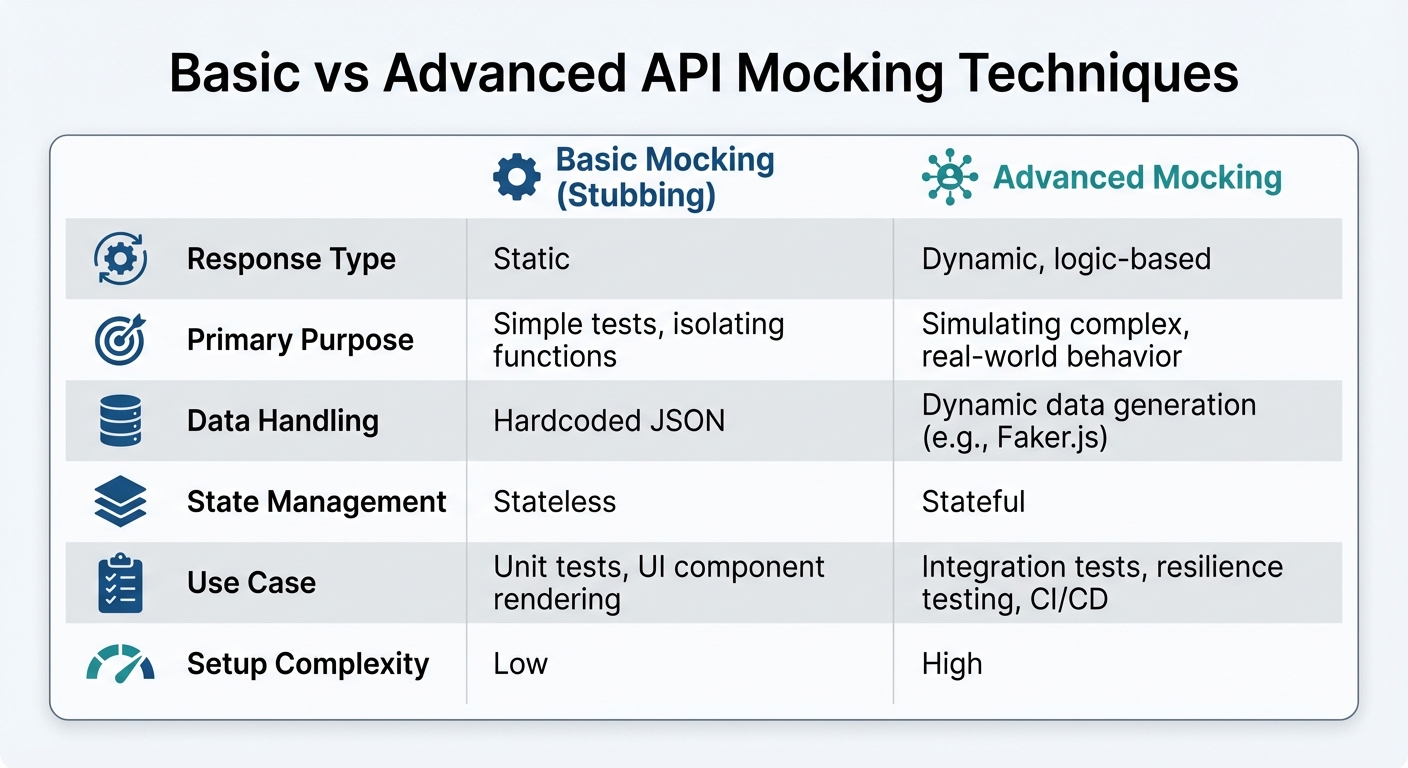
Basic vs Advanced API Mocking Techniques Comparison
Technique Comparison
API mocking has come a long way, evolving from simple static JSON files to dynamic, state-aware simulations. Developers now have two main approaches to choose from: basic stubbing and advanced dynamic mocking, each suited to different needs. Basic mocking focuses on returning fixed responses, making it a quick way to check functionality. Advanced mocking, on the other hand, mimics real-world behavior by dynamically adjusting responses, managing state (like authentication tokens), and even introducing faults such as latency or server errors.
The differences between these methods are quite clear. Basic mocking is stateless, meaning the same input consistently produces the same output. This makes it great for unit tests and rendering UI components. Advanced mocking, however, tracks state across multiple calls, generates dynamic data using tools like Faker.js, and incorporates chaos testing to see how systems handle issues like 5xx errors or network delays. Some advanced techniques can even be implemented at the API gateway level, enabling features like JWT authentication and rate limiting without modifying endpoint URLs when transitioning to production.
| Feature | Basic Mocking (Stubbing) | Advanced Mocking |
|---|---|---|
| Response Type | Static | Dynamic, logic-based |
| Primary Purpose | Simple tests, isolating functions | Simulating complex, real-world behavior |
| Data Handling | Hardcoded JSON | Dynamic data generation (e.g., Faker.js) |
| State Management | Stateless | Stateful |
| Use Case | Unit tests, UI component rendering | Integration tests, resilience testing, CI/CD |
| Setup Complexity | Low | High |
This table highlights the key differences, helping you decide which approach aligns with your testing needs.
Choosing Between Basic and Advanced Techniques
Deciding between basic and advanced mocking comes down to the complexity of your testing requirements and the architecture of your microservices. Basic stubbing is perfect for quick tests that verify isolated functions or UI components. It's simple to set up, making it ideal for early-stage prototyping or standalone services with minimal dependencies.
If you're dealing with intricate dependencies or need to simulate real-world conditions - like network delays, rate-limiting (429 responses), or server errors - advanced mocking is the way to go. This approach is indispensable for testing how systems behave under stress or when multiple services interact.
"The most effective mocks balance realism with adaptability - they evolve as your API ecosystem grows." - API7.ai
As your system matures, consider adding realistic latency (between 100ms and 2,000ms) to see how your application handles poor network conditions. To keep your mocks accurate, avoid "mock drift" by syncing them weekly with production schemas using automated OpenAPI diff tools. This practice ensures your tests stay aligned with actual API changes, boosting the resilience and reliability of your microservices.
Top Tools for API Mocking in Microservices
When it comes to API mocking in microservices, the right tools can completely transform your development process. Whether you're after lightweight local solutions or enterprise-level platforms, the key is finding a tool that aligns with your architecture and team needs. Below are some standout options to consider.
Microcks
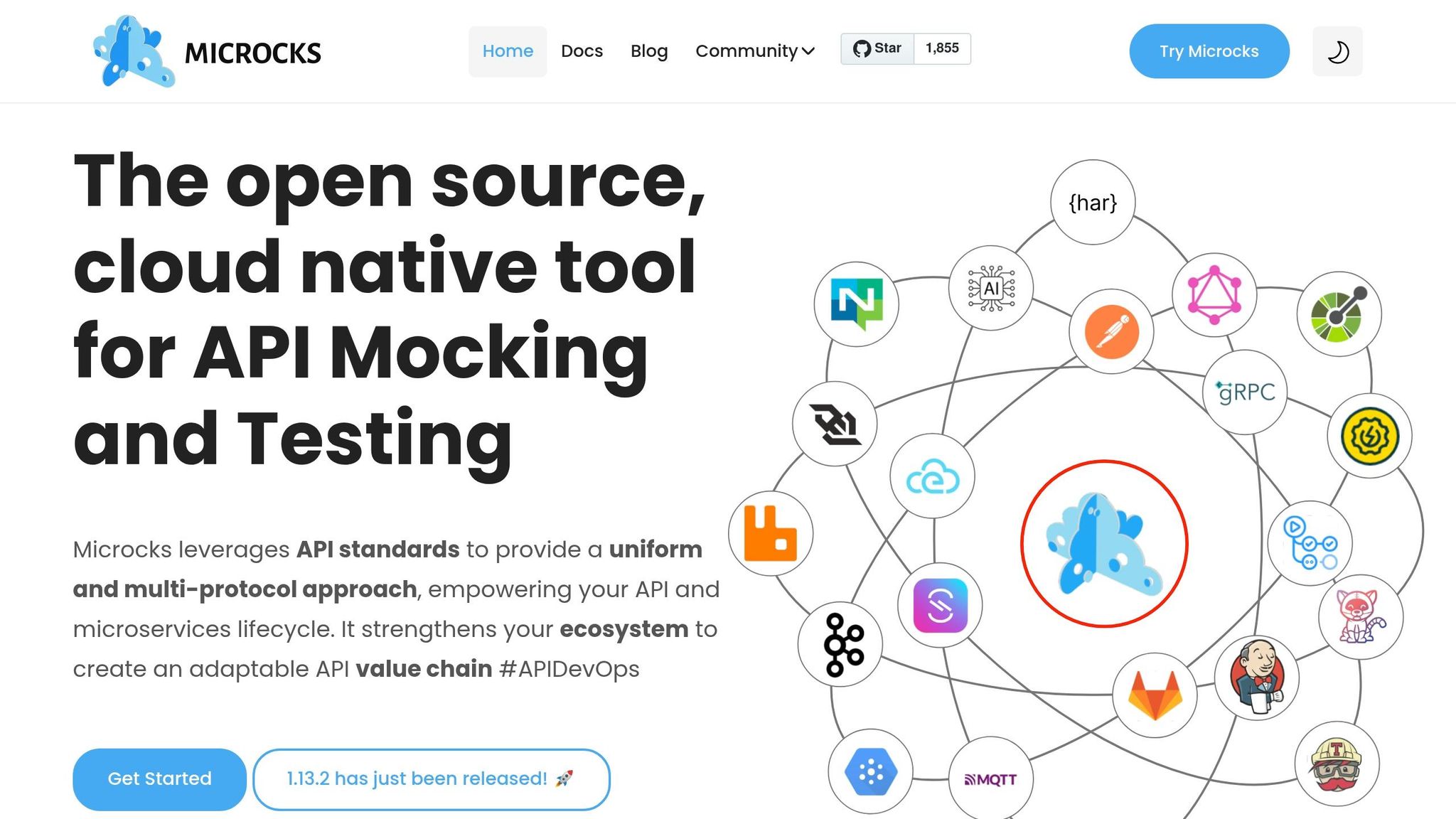
Microcks is a cloud-native solution designed to handle multiple protocols, including REST, SOAP, gRPC, GraphQL, and event-driven APIs like Kafka and RabbitMQ. It automates mock generation using standards like OpenAPI and AsyncAPI, cutting down on manual setup. Plus, it supports contract testing for both API providers and consumers, ensuring your mocks stay in sync with real-world specifications. Deployment is flexible, with options for Kubernetes, Docker, or on-premise setups, and being open-source means no licensing fees.
"Microcks leverages API standards to provide a uniform and multi-protocol approach, empowering your API and microservices lifecycle." – Microcks
For simpler local development needs, you might want to explore tools like Mockoon.
Mockoon
Mockoon is perfect for developers who prioritize speed and privacy. It runs entirely on your local machine, requires no account, and is ideal for offline work. Its user-friendly interface lets you design REST APIs in seconds, making it a go-to for rapid prototyping and frontend development.
Jan Bílek, Product Manager, said: "Mockoon was easy to start with, was fast and lightweight. One clear purpose tool which immediately solved our problem."
Beyond local use, Mockoon offers a CLI for headless environments, Docker compatibility, and even serverless deployment options for AWS Lambda and Google Cloud Platform. It also includes chaos engineering features to simulate network issues, latency, and malformed responses. While the core tool is free and open-source, Mockoon Cloud adds team collaboration and centralized deployments.
WireMock
WireMock is a powerhouse for stateful mocking and fault injection, making it essential for testing how microservices perform under real-world conditions. It supports advanced HTTP mocking with detailed request matching based on URL, headers, and body content. Using Handlebars templating, it can dynamically generate responses. WireMock also excels in resilience testing, letting you simulate faults like network delays and 5xx errors.
"WireMock gives us an extra day every week for every developer on the team." – Trevis Halladay, Director of Software Development, Fortune 100 Media Company
WireMock Cloud users have reported setting up tests 90% faster and saving an average of 10 hours per week. Some teams even saw their release cycles shrink to one-third of their original length. While the core engine is free and open-source, WireMock Cloud offers premium features like AI-driven mock generation through its Model Context Protocol (MCP) server.
If your team needs advanced proxying, the next tools might be a better fit.
MockServer and Postman
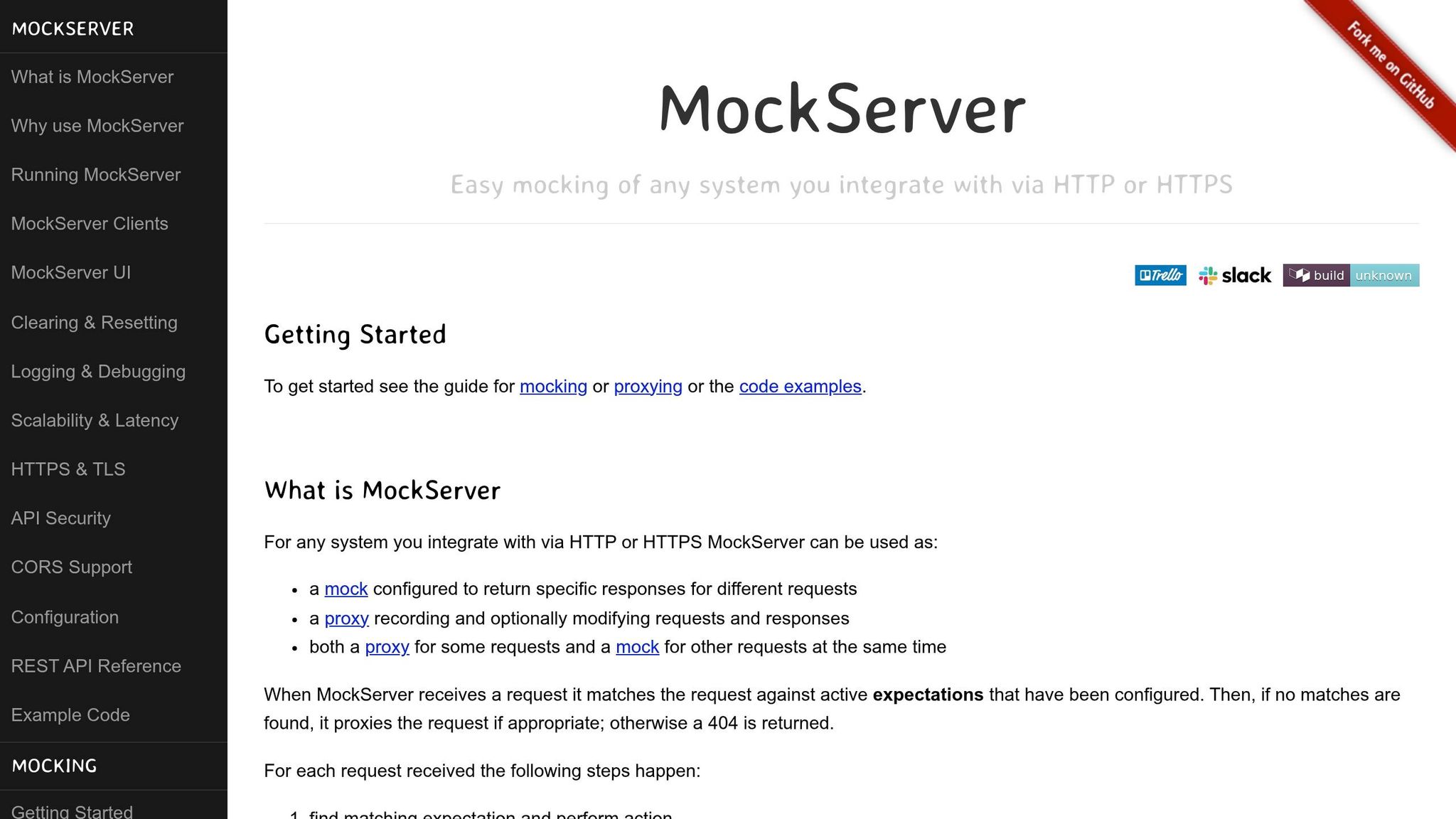
MockServer is built for advanced proxying and request verification. It includes features like SOCKS proxying, port forwarding, HTTPS tunneling, and automatic SSL certificate generation. Its record-and-replay functionality is especially useful for analyzing system behavior by capturing outbound requests. With deployment options like Java, Docker, npm, and Grunt, MockServer is a versatile, open-source choice for teams tackling complex proxying challenges.
Postman, on the other hand, serves as an all-in-one API lifecycle platform. While it’s often paired with other mocking tools, it’s particularly useful for teams already invested in Postman’s ecosystem. Its comprehensive features - from design to monitoring - can be a bit overwhelming, but they provide a centralized way to manage APIs.
| Tool | Primary Strength | Key Protocols | Best For |
|---|---|---|---|
| Microcks | Multi-protocol & Contract Testing | REST, SOAP, gRPC, GraphQL, AsyncAPI | Diverse architectures mixing sync/async |
| Mockoon | Local Speed & Simplicity | REST | Rapid prototyping, frontend development |
| WireMock | Stateful Mocking & Fault Injection | REST, gRPC, GraphQL, SOAP | Java microservices, resilience testing |
| MockServer | Advanced Proxying & Verification | HTTP/HTTPS | Recording traffic, complex proxying needs |
Each of these tools offers unique strengths, making them valuable additions to your toolkit. They pave the way for stronger mocking strategies, which we’ll delve into further in the upcoming best practices section.
Best Practices for API Mocking in Microservices
When it comes to API mocking in microservices, a few best practices can make all the difference in ensuring your mocks remain useful throughout the development process. These practices help teams avoid wasted effort and maximize the value of their mocks.
Start Early in the Development Lifecycle
One mistake teams often make is treating mocks as an afterthought. Instead, adopt a contract-first development approach, using OpenAPI or GraphQL schemas as your single source of truth. This method allows frontend and backend teams to work in parallel without delays or bottlenecks. In fact, 74% of organizations now use API-first development, up from 66% the previous year, according to Postman's 2024 State of the API Report.
By generating mocks directly from these specifications, you eliminate guesswork and ensure everyone is on the same page. Start by tackling your biggest pain point - identify the external dependency causing the most delays or flaky CI tests, and replace it with a mock first.
Prevent Mock Drift
Mock drift can lead to unreliable tests and integration issues. The solution? Automate drift detection. Synchronize your mocks with production schemas on a weekly basis and use OpenAPI diff tools to catch changes before they cause problems.
Store your mock definitions in Git alongside your service code. This ensures every branch has an up-to-date, synchronized mock. Tools like WireMock’s --watch flag can hot-reload specifications after each commit, making local development smoother. Additionally, if you're using GitHub Actions, set up workflows to automatically update your mocking platform whenever changes to the openapi.yaml file are pushed to the main branch. This strategy avoids the dreaded "mock-reality drift", where tests pass using outdated mocks, but real-world integrations fail.
Integrate Mocks into CI/CD Pipelines
To keep the feedback loop tight during development, integrate mocks directly into your CI/CD pipelines. Use headless tools like Mockoon CLI or WireMock Docker images to spin up mock servers automatically in your pipelines. For example, one fintech company saved $15,000 annually by using mocks to bypass third-party API fees during testing.
Go a step further by simulating real-world conditions. Program mocks to return 4xx/5xx errors for 15% of requests and introduce network latency between 100–2000ms to test system resilience.
"Mock APIs aren't a 'nice-to-have' any more - they're the only way to ship fast without sacrificing reliability".
| Strategy | Implementation | Primary Benefit |
|---|---|---|
| Contract-First | Generate mocks from OpenAPI/GraphQL schemas | Enables parallel work for frontend and backend teams |
| Automated Drift Detection | Weekly schema sync + OpenAPI diff tools | Avoids unreliable tests and integration failures |
| CI/CD Integration | Docker/CLI-based mock servers in pipelines | Faster execution and reduced costs |
| Chaos Injection | Simulate errors and latency in mocks | Verifies system resilience under stress |
For even more robust testing, use dynamic data generators like Faker.js instead of static JSON. Add a CI job to ensure mock responses are faster than real API calls to avoid performance issues. For critical deployments, consider dark launching mocks by routing 1% of production traffic to them for canary testing.
Conclusion
This guide has explored how API mocking can transform microservices development by reducing costs, improving efficiency, and enhancing system resilience. With organizations embracing API-first development at a 74% adoption rate, the impact is clear. Mock endpoints have been shown to execute CI/CD tests up to 300% faster than real APIs, enabling companies like Spotify to accelerate feature delivery by two weeks. Similarly, fintech teams have reported saving $15,000 annually by avoiding unnecessary third-party API calls during testing.
The strength of API mocking lies in its ability to decouple dependencies. By allowing frontend and backend teams to work in parallel through contract-first approaches, development bottlenecks are minimized. Simulating scenarios like 5xx errors, latency spikes, and rate limits ensures systems are prepared for real-world challenges. Running CI/CD pipelines on lightweight mocks instead of full service stacks adds another layer of confidence when rolling out new features. This decoupling is a cornerstone of building scalable and resilient microservices ecosystems.
The key takeaway? API mocking isn't just a tool - it's a strategy. Treat mocks as dynamic, evolving artifacts rather than static files. Automate drift detection, integrate mocks into your pipelines from the start, and use them to simulate realistic failures to test edge cases. Whether you opt for curated development tools like WireMock for complex scenarios, Mockoon for quick local setups, or cloud-native solutions like Microcks, the success of your approach will depend on how well you maintain alignment between mocks and reality.
"The real question isn't whether to adopt API mocking, but whether you can afford not to." - Zuplo
FAQs
When should I use mocking vs a real test environment?
Mocking is perfect for situations like early development, prototyping, or testing edge cases when the actual API isn’t available, is too slow, or incurs high costs. It speeds up testing by providing a controlled environment without depending on the real backend.
However, real test environments are essential for validating integration, authentication, and production-like behavior. They ensure the application works as expected with real data. Start with mocking, but always move to real environments for the final checks.
How do I stop my mocks from getting out of sync with the real API?
To ensure your mocks stay aligned with the actual API, rely on contract testing. This approach checks that mock responses mirror the API's real behavior. Pair this with dynamic mocking techniques, such as path-based status simulation, which lets you tweak mock behavior as the API changes over time. Regular updates to mock configurations and automated testing are key to catching discrepancies early, maintaining reliable and consistent testing processes.
Which mocking tool fits my microservices stack?
Several tools are designed to address various microservices requirements:
- Mockintosh: Known for its flexible mocking capabilities, it supports features like parameterized URLs and works seamlessly with Kafka and AMQP.
- Microcks: A great choice for handling diverse API standards, as it supports multiple protocols, including REST, SOAP, and GraphQL.
- WireMock: This open-source tool is highly adaptable and works well in local or testing environments.
- Speedscale: Tailored for Kubernetes environments, it simplifies API mocking for those using containerized applications.
- Zuplo: A cloud-native option that's easy to deploy, making it ideal for modern, scalable solutions.